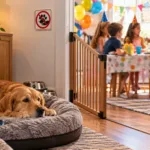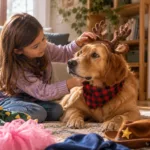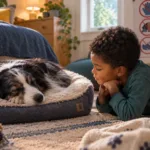
A pet retreat is a predictable, comfortable place where an animal can rest away from unwanted contact, noise, and repeated interruptions.
At first, the family thought he was simply being social. Then they noticed that he rarely had a quiet place to go. When the children became loud, he moved from room to room, looked away, licked his lips, and kept searching for somewhere the activity could not reach him.
That was the beginning of a useful change: creating a space where the pet could retreat without being followed, corrected, or pulled back into the family’s activity.
🐾 A safe space is not a punishment corner. It is a predictable place where a pet can lower the pressure and choose when to return.
Why Loud Family Moments Can Build Up Over Time
A single burst of noise is different from a household where the pet has no reliable way to escape repeated noise, chasing, touching, or interruption. Children may not intend to overwhelm an animal. They may simply be running, playing, singing, arguing, or moving quickly through the same space.
One Loud Moment Is Different From Constant Exposure
Pets can often recover from ordinary family noise when they can pause afterward. The concern grows when the animal remains on alert because every resting spot can be invaded and every attempt to move away is followed.
The Pet May Look Fine Until It Does Not
Not every uncomfortable pet growls or snaps. Some become unusually quiet, turn their heads away, lick their lips, yawn, hide, freeze, or stop approaching the family. Those early changes deserve attention before the animal feels forced to communicate more strongly.
Reading the whole animal is more useful than waiting for one dramatic sign.
What a Safe Retreat Actually Is
A safe retreat is a consistent, comfortable area that reduces the chance of unwanted contact. It can be a bed behind a gate, a quiet corner, a crate used positively, a raised platform, a cat tower, a separate room, or a protected section of a small pet’s enclosure.
A Retreat Is Not a Punishment
Do not send the pet to the retreat angrily after it has “misbehaved.” If the space only appears after a scolding, the animal may associate it with trouble rather than relief. Introduce it during calm moments and make it part of ordinary rest.
The Pet Must Be Able to Choose It
Whenever possible, the pet should be able to enter voluntarily. During a particularly busy event, an adult may use a gate or separate room to prevent children from following, but the area should remain comfortable and never feel like a trap.
🐾 Choosing the Right Location
The best location balances inclusion and protection. The pet can remain aware of family life without being placed in the center of every movement.
Near Enough to Feel Included
A dog may prefer a bed in the corner of the living room or behind a gate near the family. A cat may choose a high shelf or tower where it can observe without being reached. A pet that wants to remain near its people should not automatically be banished to an isolated room.
Far Enough to Avoid Constant Touch
The space should not sit in the middle of the hallway, beside the toy basket, or under the table where children naturally crawl. Make it difficult for a child to stumble into the area, lean over the pet, or block the exit.
What to Put Inside the Retreat
- A comfortable bed, mat, blanket, or species-appropriate resting surface
- Fresh water when the area is used for longer periods
- One safe, familiar toy if the pet enjoys having it there
- Shade, ventilation, and a comfortable temperature
- A clear entrance and exit
- A visual boundary that children understand
Match the Setup to the Species
| Pet | Possible retreat | Important detail |
|---|---|---|
| Dog | Bed behind a gate, quiet corner, open crate, or accessible room | Never let children follow, block, or reach into the space |
| Cat | High shelf, tower, covered bed, box, or child-free room | Provide height and a route away from hands |
| Small mammal | Protected hide inside a stable enclosure | Keep the enclosure away from banging, grabbing, and sudden movement |
| Pet with medical needs | Controlled, adapted area | Follow veterinary instructions and limit child access |
Keep Food and High-Value Items Protected
If the pet guards food, chews, toys, or bedding, do not use those items in a child-accessible retreat without a clear safety plan. Children should never reach into a bowl, remove an object, or enter the space to “help” the pet.
📋 How to Teach the Pet to Use the Space
Introduce It on Calm Days
Place the bed, mat, crate, or platform in the chosen location before the house is busy. Let the pet investigate without pressure. For a dog, you can toss a treat onto the mat and praise voluntary entry. For a cat, allow exploration on its own terms.
Reward Voluntary Use
When the pet chooses the space, do not immediately call it out for attention. Let the retreat remain restful. Calmly reinforce the choice if appropriate, then allow the pet to stay.
Practice a “Break” Cue
For dogs, a gentle cue such as “go to your spot” can be practiced for a few seconds at a time. The cue should guide the dog toward a comfortable option, not force it into confinement. Practice when nobody is upset.
The ASPCA recommends creating safe zones, teaching a dog to use them, giving the animal a way to walk away, and teaching children to respect the dog’s body, belongings, and retreat area. The same principle applies to any household where children and pets share busy spaces.
Teaching Kids the Retreat Rules
Children need rules they can remember in the middle of excitement. Use the same short phrases every time.
- “When the pet is there, we do not follow.”
- “The bed is not a play area.”
- “Ask before touching.”
- “The pet can take a break.”
- “An adult helps when we are not sure.”
Practice the rules when the children are calm. Point to the retreat and act out what happens: the child stops at the boundary, lowers their voice, and moves away. Do not wait for a real crisis to introduce the idea.
How to Use the Retreat During Real-Life Chaos
Before the Noise Starts
Before a birthday party, playdate, house project, vacuuming session, or energetic game, check that the retreat is available. Put away anything that children might try to take from the pet, close a gate if needed, and remind the children of the rules.
During the Loud Moment
Lower the pressure instead of repeatedly calling the pet. Ask children to move their game away from the retreat. Reduce noise where possible, and let the animal choose whether to remain nearby or leave.
After the House Gets Quiet
Do not immediately send children into the retreat to welcome the pet back. Leave the area quiet and allow the animal to return on its own. A pet that comes out should not automatically be surrounded.
Signs the Pet Needs a Break
| Signal | What it may mean | Recommended response |
|---|---|---|
| Turns head away or avoids contact | Less pressure is needed | Move children back and reduce stimulation |
| Yawns, licks lips, or hides | Discomfort or uncertainty is increasing | End the interaction and offer the retreat |
| Body becomes rigid or still | The pet may feel trapped or tense | Separate calmly and immediately |
| Walks voluntarily into the retreat | The pet is choosing a pause | Do not follow, touch, or remove it |
| Returns with relaxed body language | The pet may be ready to rejoin | Allow reentry without crowding |
Signals are not a perfect checklist. Look at the whole situation, the pet’s normal behavior, and the speed of the change. When in doubt, create more distance.
What Not to Do With a Safe Retreat
- 🚫 Use the retreat only after the pet “misbehaves.”
- 🚫 Allow children to crawl inside, knock on the crate, or reach through the gate.
- 🚫 Pull the pet out because visitors want to see it.
- 🚫 Block the only exit with furniture or toys.
- 🚫 Force a fearful pet into the space without a gradual plan.
- 🚫 Assume the pet is safe simply because it is quiet.
How to Know If the Space Is Working
Success is not that the pet stays in the retreat all day. A useful space may show its value through small changes:
- The pet enters voluntarily before or during busy moments.
- The animal rests more deeply instead of pacing from room to room.
- Children stop following or interrupting the pet.
- The pet returns to family life with a more relaxed body.
- Adults notice early signals and intervene sooner.
If the pet never uses the space, examine the location. It may be too exposed, too hot, too isolated, too close to noise, or associated with being forced inside. Try a different setup and introduce it slowly.
When a Retreat Is Not Enough
A retreat can reduce pressure, but it cannot solve every behavior problem. Ask a veterinarian or qualified behavior professional for guidance if the pet shows intense fear, repeated escape attempts, sudden aggression, self-injury, resource guarding, or a major change from normal behavior.
Young children should not be left alone with animals, even when the animal has always seemed gentle. HealthyChildren.org places ultimate responsibility for a child’s safety around animals on the parent and advises that young children never be left alone with a pet. A retreat supports supervision; it does not replace it.
A Family Safe-Retreat Checklist
- ☐ The location is quiet enough to support rest.
- ☐ The pet can enter voluntarily and leave safely.
- ☐ The bed, crate, platform, or enclosure matches the species and individual pet.
- ☐ Children know not to follow, touch, tease, or reach into the space.
- ☐ Food, chews, toys, and medical items are managed safely.
- ☐ Adults supervise all child-pet interactions.
- ☐ The family practices using the retreat on calm days.
- ☐ The setup is reviewed when the pet, child, furniture, or routine changes.
FAQ
Should I close the door when the pet enters?
Sometimes a closed door or gate is needed during a party, repair, or period when adults cannot supervise. When possible, introduce that separation gradually and make sure the pet has water, comfort, ventilation, and enough space for the duration.
Can a crate be a safe retreat?
Yes, if the dog has learned to view the crate as a comfortable place and is never forced into it as punishment. The crate should be appropriately sized, ventilated, and managed according to the dog’s individual needs.
Should I put food inside the retreat?
Only if the pet can eat there safely and children cannot approach the food. For animals that guard resources, use adult-managed feeding areas and avoid creating a new conflict around the retreat.
What if my pet refuses to use the space?
Do not push the pet inside. Reconsider the location, bedding, temperature, noise, access, and whether the space has become associated with being trapped. Introduce it again during calm moments.
What if my child keeps invading the retreat?
Increase physical separation and supervise more closely. Use a gate, closed room, or separate activity while you teach the rule. The pet’s retreat should not depend on a young child remembering perfectly.
Final Thoughts: Give the Pet a Way to Say “Not Right Now”
A safe retreat gives a pet something many busy households accidentally remove: control over distance. The animal can stay near the family, step away from noise, rest without interruption, and return when the environment feels manageable again.
Safe location + voluntary access + child-free boundaries + adult supervision = a calmer way to share a busy home.
The goal is not to hide the pet from family life. It is to prevent every family moment from becoming the pet’s responsibility to endure.
Where could your pet rest undisturbed while still feeling connected to the household?
Sources and Further Reading
These trusted resources informed the guidance on safe retreats, canine communication, supervision, and child-pet boundaries:
- ASPCA: Dogs and Babies — explains safe zones, retreat options, and teaching children to respect a dog’s space and belongings.
- HealthyChildren.org / American Academy of Pediatrics: How to Choose the Right Pet for Your Family — reinforces adult supervision and safe handling around children and animals.

A father of three and a lifelong dog owner who started CentralUnify.com after years of figuring out — often the hard way — how to raise kids and pets who genuinely get along. Between school mornings, homework, and life with two very different dogs, Biscuit (an easygoing older lab) and Pepper (a younger terrier mix with a mind of her own), he’s learned a thing or two about keeping a busy household running without losing his sanity. When he’s not writing, he’s probably refereeing whose turn it is to feed the dogs.