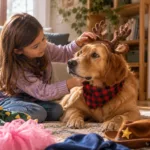
Children often want to greet an interesting animal they see in public, at a park, outside a store, or while visiting another household. A safe greeting begins before the child reaches out: the child must ask the person responsible for the animal, wait for an answer, and accept no as the final answer.
Teaching how to teach kids petting manners is not mainly about making every animal interaction friendly. It is about teaching consent, observation, patience, and respect for an animal that belongs to someone else. The owner or handler decides whether contact is appropriate.
🐾 The basic sequence: Stop, ask the responsible adult, wait for permission, let the animal choose whether to approach, and leave calmly if the answer is no.
Teach Permission Before Touch
Before a child reaches toward an unfamiliar pet, teach the child to pause and find the person responsible for the animal. Permission should come from the owner, handler, or another adult who can make that decision, not from the child’s excitement or from the animal simply being nearby.
The AVMA’s dog-bite prevention guidance is dog-specific and tells children to ask the owner before petting an unfamiliar dog. The guidance also says children should not reach through fences and should leave dogs alone when they are eating, sleeping, or moving away.
| 🧭 Step | What the child does | What the adult teaches |
|---|---|---|
| Stop | Keep hands by the body | Excitement is not permission |
| Ask | Speak to the responsible adult | The owner knows the animal’s comfort level |
| Wait | Stand still and listen | Yes, no, or not now are all valid answers |
| Observe | Notice whether the animal approaches calmly | An animal can decline contact |
| Leave | Step away if contact is not invited | Respect includes accepting no |
Permission Is Not the Same as Guaranteed Contact
An owner may agree that the child can try to greet the animal, but the animal still gets to move away. Permission means the situation may be suitable for a careful introduction; it does not require the pet to approach, remain nearby, or accept touch.
The ASPCA’s dog-bite prevention guidance is also dog-specific. It recommends asking first, allowing the dog to sniff a closed hand if the owner agrees, and stopping when the dog appears uncomfortable. It also advises avoiding dogs that are loose, behind a fence, tied up, barking, growling, fearful, or anxious.
👀 Look for an Invitation, Not an Opportunity
A child should not interpret a wagging tail, a quiet posture, or physical closeness as automatic permission. Body language can be difficult to read, and different animals communicate discomfort in different ways. The owner’s answer and the animal’s willingness to approach both matter.
Teach a Calm Greeting After Permission
If the responsible adult agrees and the animal approaches willingly, the greeting should remain brief and gentle. The child can stand still, keep the voice quiet, and allow the animal to investigate without leaning over it or putting a face close to the animal’s face.
- 👐 Keep hands slow and visible.
- 🐾 Avoid grabbing, hugging, lifting, sitting beside, or pulling the animal.
- 🙂 Follow the owner’s instructions about where touch is appropriate.
- ⏳ Stop after a short greeting instead of repeatedly asking for more contact.
- 🚶 Step away when the animal turns away, stiffens, hides, or moves off.
Adults should supervise the entire interaction. Young children must never be left alone with an unfamiliar animal, even when the owner has given permission and the first contact appeared calm.
Why Fences and Cars Are a No-Touch Zone
Teach children never to reach through or over a fence, gate, window, or vehicle opening to touch an animal. The barrier may limit the animal’s ability to move away, and a hand entering the animal’s space can be interpreted as a threat.
An animal inside a car may be tired, frightened, protective of the vehicle, or unable to leave. A child should not knock on the window, open a door, put fingers through a gap, or ask the animal to come closer. The correct action is to keep distance and continue walking.
The same rule applies to animals behind gates, in yards, inside crates, or attached to a tether. A barrier is not an invitation to reach closer. If contact is appropriate, the responsible adult can bring the animal into a safer, open setting.
Do Not Interrupt Animals That Are Working
Some animals are performing a task rather than participating in social interaction. A child should not pet, call, feed, distract, or move toward an animal that is guiding, alerting, assisting, guarding, or working with a handler.
The U.S. Department of Justice’s ADA guidance explains that service animals are dogs trained to perform a task directly related to a person’s disability. Because a working service animal must focus on its handler and task, teach children to look without approaching or distracting it unless the handler clearly invites contact.
The same courtesy can apply to therapy animals, farm-working animals, security animals, and any pet whose handler says it is busy. The child does not need to know the animal’s job or ask personal questions about the handler’s disability.
What to Do When the Owner Is Not Present
No responsible adult available means no touching. A child should not assume that an unattended animal is friendly, lost, waiting to be greeted, or asking for help. The child should keep distance and tell a trusted adult if there is an immediate safety concern.
- 🚫 Do not open a gate, vehicle, crate, or enclosure.
- 🚫 Do not offer food or try to lure the animal closer.
- 🚫 Do not follow an animal that walks away.
- 📣 Tell a trusted adult if the animal appears injured, trapped, or in immediate danger.
How to Respond When the Child Insists
Some children may continue asking, move closer after a no, or argue that the animal looks friendly. Keep the response calm and brief. The adult can repeat that the owner decides and that the child’s job is to step back.
Do not turn the moment into a debate about whether the animal is nice. A friendly animal can still be tired, fearful, protective, ill, or uninterested in contact. The child can practice accepting the answer by choosing another activity, waving from a distance, or watching without approaching.
If the child continues to approach, the adult should physically guide the child away without reaching toward the animal. If the animal shows fear, tension, growling, hissing, snapping, or another warning signal, increase distance immediately. Warning signals should not be punished.
Teach the Difference Between Curiosity and Safe Contact
| 🔍 Curiosity | ⚠️ Risk | Adult response |
|---|---|---|
| Asking what kind of animal it is | Reaching without permission | Pause the hand and redirect to asking |
| Watching from a distance | Following when the animal leaves | Stop the pursuit and create space |
| Listening to the owner’s instructions | Arguing after the owner says no | End the interaction |
| Noticing a leash or harness | Pulling the leash or touching equipment | Keep hands away and step back |
Curiosity is welcome when it stays at a safe distance. The goal is not to eliminate a child’s interest in animals, but to teach that interest does not create a right to touch.
📋 A Simple Petting-Manners Checklist
- ☐ Stop before reaching.
- ☐ Ask the responsible adult for permission.
- ☐ Wait for the answer without moving closer.
- ☐ Let the animal choose whether to approach.
- ☐ Keep away from animals behind fences, inside cars, or in restricted areas.
- ☐ Never distract an animal that is working.
- ☐ Leave calmly when the owner says no or the animal moves away.
- ☐ Tell an adult if the animal appears unsafe, injured, or loose.
FAQ About Children Petting Other People’s Animals
What should a child say before touching a dog?
The child can politely ask the responsible adult whether the dog may be greeted. The exact wording matters less than stopping, asking, waiting, and accepting the answer.
What if the owner says yes but the animal moves away?
The child should stop and let the animal leave. Permission from the owner does not override the animal’s choice to avoid contact.
Can children pet animals behind fences?
No. Children should not reach through or over fences, gates, car windows, crates, or other barriers. A responsible adult would need to create a safe, open setting before contact is considered.
What if the child keeps insisting?
End the interaction, move the child away, and redirect to another activity. Repeating the request does not change the owner’s answer or create permission.
Final Thoughts: Good Manners Protect Both Sides
Asking before touching teaches children that animals are living individuals, not public objects. The child learns to respect the owner’s decision, the handler’s work, and the animal’s choice to approach or leave.
Stop, ask, wait, observe, and accept no. These simple habits help children enjoy safe encounters without turning curiosity into pressure or risk.
What phrase or routine helps your child remember to ask before petting an unfamiliar animal? Share what has worked for you in the comments.
Sources and Further Reading
- American Veterinary Medical Association: Preventing Dog Bites — dog-specific guidance on asking permission, allowing the dog to approach, fences, warning signs, and supervision.
- ASPCA: Dog Bite Prevention — dog-specific guidance on asking before petting, body language, fences, and avoiding fearful or aggressive dogs.
- Blue Cross: Keeping Your Family Dog and Visiting Children Safe — dog-specific guidance on gentle interaction, allowing a dog to approach, and stopping contact when the dog moves away.
- U.S. Department of Justice, ADA.gov: Service Animals — official information explaining that service animals are trained to perform tasks related to a person’s disability.
A father of three and a lifelong dog owner who started CentralUnify.com after years of figuring out — often the hard way — how to raise kids and pets who genuinely get along. Between school mornings, homework, and life with two very different dogs, Biscuit (an easygoing older lab) and Pepper (a younger terrier mix with a mind of her own), he’s learned a thing or two about keeping a busy household running without losing his sanity. When he’s not writing, he’s probably refereeing whose turn it is to feed the dogs.