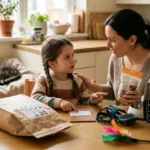
Children often notice small details in a family pet’s day: whether the animal comes to a usual greeting, settles in a familiar place, or follows a familiar part of the household routine. Teaching a child to report a change means helping them share what they observed—not asking them to decide what it means.
The adult should listen, check the context, and decide whether to monitor the pattern or contact a veterinarian. A changed routine can have many explanations, including a change in the household schedule. One observation is not a diagnosis, and the child should not be made responsible for evaluating the pet’s health.
🐾 The child notices and reports. The adult checks, decides what to do, and remains responsible for the pet’s care.
What Counts as a Change Worth Reporting?
A useful observation is a specific difference from a pattern the family has seen repeatedly. It does not need to be alarming. For example, a child might notice that the pet did not come to its usual spot during a familiar part of the day, chose a different place to rest, or did not join an ordinary household activity. These are details to share, not signs the child must interpret.
Routine is not a rigid timetable. Pets may vary from day to day, and family life changes too. Before drawing conclusions, an adult can check whether meal or walk times shifted, visitors came, the weather changed, or another everyday event affected the usual pattern. The goal is to report a difference accurately—not to expect a pet to behave identically every day.
| What the child notices | How to report it | What the adult checks |
|---|---|---|
| The pet did not come to its usual greeting | Describe what happened and when | Whether the timing or household routine changed |
| The pet rested in a different place | Say where it rested, without guessing why | Whether this is new, repeated, or linked to a change nearby |
| The pet skipped a familiar activity | Tell an adult which activity and what was different | Whether the pet’s overall behavior or needs have changed |
The examples are deliberately ordinary and observable. Children do not need to watch the pet all day, test whether it responds, or keep checking on it. They can share something they happen to notice and then return to their own activities.
Teach a Simple Notice-and-Tell Method
A short sequence can help a child communicate without turning them into a pet monitor:
- Notice one concrete detail. Focus on an action or event the child actually saw, such as the pet staying in a different resting spot at a familiar time.
- Compare it with the usual pattern. Help the child describe what is different without labeling the pet as “sick,” “sad,” or “bad.”
- Share when and where it happened. The adult can ask whether it happened once or more than once and whether anything else in the routine changed.
- Tell an adult and let them take over. The child does not need to keep observing, repeat a test, touch the pet, or solve the situation.
Keep questions neutral and brief. Asking what the child saw, when it happened, and what normally happens at that time can clarify the report. Avoid leading questions that suggest a diagnosis or pressure the child to produce an explanation. If the child is unsure, it is fine to say they are not sure.
Make Reporting Easy and Reassuring
Children may hesitate if they fear being blamed, being told they are wrong, or having to fix the situation. Respond calmly and thank them for sharing. An adult can check the pet and the routine without treating the report as proof that something is wrong.
For younger children, a simple reminder can be enough: notice a difference, tell an adult, and let the adult handle it. Older children may be able to share a clearer timeline, but they still should not be expected to keep a log, supervise the animal, or decide whether professional help is needed. Participation is voluntary and should fit the child’s age, confidence, and relationship with the pet.
A family may keep an adult-managed note if the same change recurs. Record observable facts—what happened, roughly when, how often, and what was different in the household that day. Avoid assigning motives or recording a child’s guess as a finding. The purpose is to help an adult notice a pattern and, if needed, describe it to a veterinarian.
Adult Responsibility: Observe, Assess, Decide
The child can report a difference; the adult decides what follows. Check the pet without forcing contact, consider recent changes in the home, and look at the whole situation rather than one isolated event. Do not ask a child to diagnose illness, interpret body language, change the pet’s routine, withhold food, give medication, or perform a test.
The AVMA advises contacting a veterinarian when a change in a pet’s behavior could indicate a problem. Guidance can also vary by species: Blue Cross notes that unusual behavior in dogs may be a sign of pain, while Cats Protection recommends speaking to a veterinarian if a cat behaves out of character. These sources support adult follow-up; they do not enable a child to identify the cause.
If a change is sudden, keeps recurring, or comes with signs that the pet may be ill, injured, in pain, or distressed, the adult should contact a veterinarian or another qualified professional. Seek urgent veterinary care for a possible emergency. The child’s job is to pass along the observation; deciding how quickly to act belongs to the adult and veterinary team.
A Quick Checklist for Adults
When a child reports a change, use this short check to keep the response factual and calm:
- ☐ What exactly did the child see or hear?
- ☐ When and where did it happen?
- ☐ Is this a one-time difference or a repeated pattern?
- ☐ Did the household schedule, environment, visitors, or activity change?
- ☐ Does the pet seem ill, injured, in pain, distressed, or difficult to manage?
- ☐ Should an adult contact the veterinarian or another qualified professional?
This checklist is for adults, not a responsibility to assign to a child. If a child becomes worried or the pet is distressed, calmly move the child away and let an adult manage the next step.
Common Mistakes to Avoid
- Turning observation into diagnosis. A routine change does not tell a child what caused it.
- Making the child responsible for monitoring. The child can report what they notice naturally; adults remain responsible for care and follow-up.
- Repeatedly testing the pet. Do not ask the child to call, touch, move, or prompt the animal to see whether it responds.
- Dismissively correcting the child. If the detail is mistaken, clarify gently and thank them for trying to communicate.
Final Thoughts
Teaching children to report changes in a pet’s routine is about clear communication, not medical judgment. Help the child describe what they noticed, when it happened, and what usually happens instead. Then let an adult check the context, decide whether the change needs attention, and contact a professional when appropriate.
Sources and Further Reading
- American Veterinary Medical Association: Pet Ownership — guidance on monitoring a pet and involving a veterinarian when behavior changes may signal a problem.
- Blue Cross: How to Spot if Your Dog Is in Pain — observable changes in a dog’s behavior and when to contact a vet.
- Cats Protection: Managing Cat Behaviour — what an out-of-character change in a cat may warrant discussing with a veterinarian.

A father of three and a lifelong dog owner who started CentralUnify.com after years of figuring out — often the hard way — how to raise kids and pets who genuinely get along. Between school mornings, homework, and life with two very different dogs, Biscuit (an easygoing older lab) and Pepper (a younger terrier mix with a mind of her own), he’s learned a thing or two about keeping a busy household running without losing his sanity. When he’s not writing, he’s probably refereeing whose turn it is to feed the dogs.