
My daughter was eleven months old the first time her hand shot toward our dog’s tail.
She couldn’t say a single word yet. She definitely couldn’t understand a sentence like “please be gentle.”
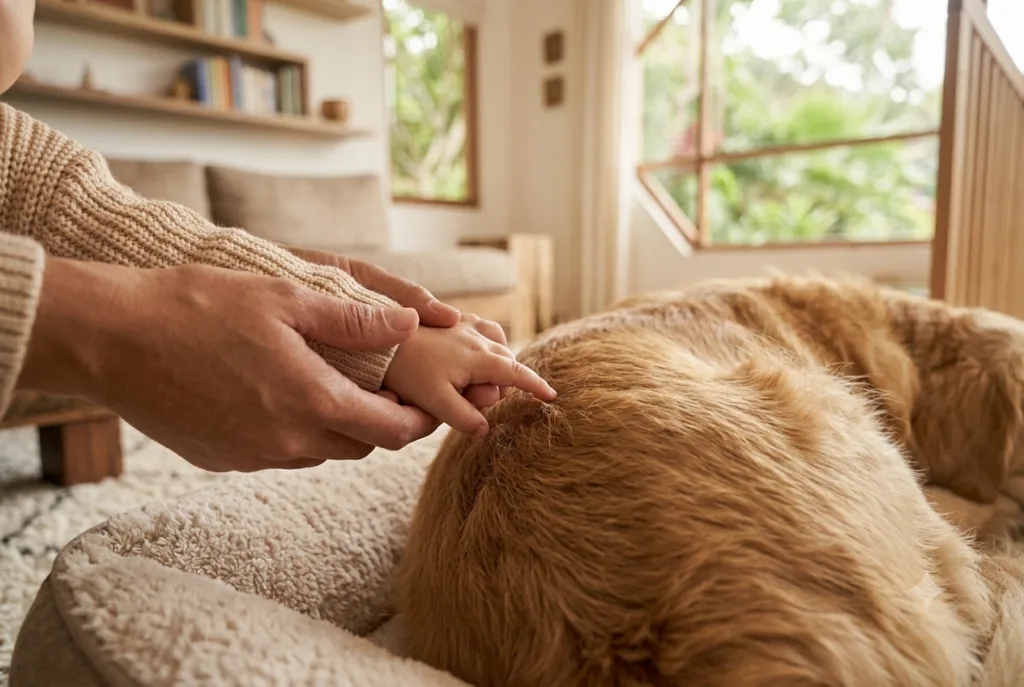
So I did the only thing that made sense in that split second: I guided her hand myself, slowly, and showed her what a gentle touch felt like. That moment is where my whole approach to gentle hands baby training really started.
That’s really the whole idea behind gentle hands baby training. You don’t wait for words. You model the behavior long before your child can follow instructions.
🐾 The basic idea: Don’t wait for your child to understand the words. Show the behavior, guide the movement, and repeat it consistently.
Why “Gentle Hands” Starts Before Your Baby Can Talk
Babies learn about the world through movement, observation, and repeated experiences, not through explanations.
That makes everyday interactions with a family pet valuable teaching opportunities, even before your child can talk back.
🍼 Babies Learn Through Watching
Young children imitate the actions they see from adults and older kids. The CDC notes that toddlers imitate the actions of adults and playmates as part of typical development.
That means your hands can become the first lesson. When your child watches you calmly stroke a dog and pause when the dog moves away, you’re demonstrating exactly the behavior you want to see repeated.
🐕 Why Touching Animals Is Different From Touching Toys
A toy doesn’t have feelings, boundaries, or the ability to move away. An animal does.
Your baby may see fur as something fascinating to grab. Your job is to teach, gradually, that the dog is a living being who deserves space and gentle treatment, not an object.
The 3 Principles Behind Teaching Gentle Hands
You don’t need complicated training sessions. Every gentle hands baby routine I’ve used at home is built around three simple principles.
| 🎯 Principle | What You Do | What Your Child Learns |
|---|---|---|
| Model | Show gentle touching yourself | What “gentle” actually looks like |
| Repeat | Use the same movement every time | What to expect |
| Reinforce | Praise calm, gentle behavior | Which behavior gets attention |
The CDC recommends specific, labeled praise when toddlers show behaviors parents want to encourage. I apply that exact same principle with our dog.
1. Show Your Baby Exactly What Gentle Touch Looks Like
The first lesson doesn’t need a single word. Your baby needs to see the movement before you can expect them to copy it.
Use Your Own Hand as the Model
When your child is near a calm pet:
- ✋ Use an open hand
- 🐾 Move slowly in one direction
- ⏸️ Then stop
- 👀 Let your child watch the entire movement
I use the phrase “gentle hands” every single time, even before my daughter understood the words. The movement is the real lesson. The words come later.
Slow Down Your Movements
Fast movements can encourage grabbing. Slow movements give your child something easier to watch and imitate.
Think of your hand as a visual demonstration: slowly touch, pause, move away, repeat.
A Simple Example With a Family Dog
Your dog is lying calmly beside you. Your baby reaches toward the dog. Before the grab happens, place your own hand over the movement, guide it toward the dog’s back, make one slow stroke, then remove the hand.
That’s a complete lesson, no lecture required.
💡 Think demonstration, not lecture. Your baby doesn’t need a long explanation. Your repeated example does most of the teaching.
2. Guide Your Child’s Hand Instead of Giving Instructions
When a child is too young to follow verbal instructions, physical guidance becomes especially useful.
Use Gentle Hand-Over-Hand Guidance
If your baby’s hand moves toward the dog’s fur, calmly place your hand over theirs. Slow the movement down, guide it into a gentle stroke, then stop.
You’re not forcing your child’s hand onto the animal. You’re helping them feel what a different movement feels like.
Stop Before Grabbing or Pulling Happens
Timing matters. If you see your baby reaching toward a dog’s tail, don’t wait for the grab. Intervene early and redirect the hand before it happens.
What To Do When Your Baby Grabs Fur
- 😌 Stay calm
- ✋ Gently release the fur from your child’s hand
- 🔁 Show the gentle movement again
- 🛑 If the grabbing continues, end the interaction
The animal should never be expected to tolerate repeated rough handling while your child is still learning.
3. Use Repetition to Build the Habit
One demonstration won’t create a lasting habit, and that’s completely normal. Gentle hands are learned through repetition, not a single big lesson.
Keep the same movement every time: open hand, slow stroke, pause, stop. Over time, this sequence becomes familiar to your child.
You don’t need a 20-minute training session either. A few gentle strokes here and there throughout the day are often more practical, and easier for a baby to handle, than one long session.
4. Reward Gentle Touch Immediately
When your child uses a gentle movement, let them know you noticed. This doesn’t need to be complicated.
Instead of a generic “good job,” describe the exact behavior:
- 💬 “You touched the dog gently.”
- 💬 “Nice soft hands.”
- 💬 “That was gentle.”
- 💬 “You let the dog move.”
The CDC recommends this kind of specific praise because it helps children understand exactly which behavior earned the positive attention.
Timing matters here too. Respond immediately after the behavior, not thirty seconds later, so the connection stays clear. And keep it calm: a soft voice and simple praise is enough, you don’t need to celebrate loudly every time.
5. Teach “Gentle Hands” Without Saying “Gentle Hands”
The phrase is useful, but your child doesn’t need to understand it yet. You can build the concept entirely through gestures and repetition.
Use the same open-hand gesture every time you want to encourage gentle touching. Eventually, your child begins recognizing the cue before they even touch the animal. Try turning it into a routine:
- Show the open hand
- Approach slowly
- Touch gently
- Pause
- Give positive attention
- End the interaction
This becomes a predictable routine instead of a constant series of corrections.
What To Do When Your Baby Grabs, Pulls, or Hits
Even with good modeling, babies will sometimes grab. They’re still developing control over their hands and learning where the boundaries are. What matters most is how you respond.
Don’t scream, and don’t wait for the animal to react. Calmly intervene, separate the child’s hand from the animal, and decide whether the interaction should continue.
If your child is still calm, demonstrate gentle touching again. If the grabbing continues, end the interaction, not as a punishment, but as a safety boundary.
And remember: your pet should never be trapped in an interaction with a baby. If the animal moves away, let it leave. Don’t bring it back so your child can try again.
🐕 Your child’s lesson and your pet’s safety come first. If your baby isn’t ready for gentle contact, the correct answer may simply be to create more distance.
Create Safe Practice Opportunities
Not every moment is a good moment to practice. The animal’s condition matters just as much as your child’s.
Choose situations where the animal is already relaxed. A dog resting comfortably beside you is a better opportunity than one that’s excited, eating, or trying to leave. The American Academy of Pediatrics recommends letting dogs approach children before petting, and avoiding sensitive areas like the face and tail.
Keep early practice brief, just a few gentle touches, then move your child on to another activity. And watch the animal as closely as you watch your child: if the dog turns away, tenses up, or growls, stop the interaction right there.
A Simple Gentle Hands Routine for Babies
Once you understand the basic idea, the process becomes very simple. I use this five-step routine whenever an appropriate opportunity appears.
| 🔢 Step | What You Do | What You’re Teaching |
|---|---|---|
| 1. Approach | Keep movements slow | Calm interaction |
| 2. Show | Demonstrate an open hand | Gentle touch |
| 3. Guide | Help the hand make one slow stroke | Physical control |
| 4. Reinforce | Praise immediately | Positive association |
| 5. Release | End before it becomes rough | Respect for boundaries |
Don’t wait until your child gets frustrated or the animal gets uncomfortable to end the interaction. Ending on a calm note makes the next opportunity easier for everyone.
Common Mistakes Parents Make
Teaching a gentle hands baby routine sounds simple, but a few common mistakes can make the process harder than it needs to be.
- 🗣️ Expecting verbal commands to work. A baby who can’t understand a complex instruction can’t reliably follow one. Show the behavior instead of repeating “be gentle!”
- 😅 Allowing repeated rough touching. It’s tempting to laugh when a baby grabs fur, but intervene every single time. Consistency matters.
- 🐕 Forcing the animal to stay. Never hold a dog in place so your child can keep petting it. Respecting the dog’s choice teaches an important lesson about boundaries.
- 🏠 Assuming the family pet will always tolerate handling. Being the family dog doesn’t mean unlimited tolerance for pulling, hugging, or climbing. The American Kennel Club recommends teaching children to respect dogs’ boundaries and supervising every interaction closely.
Gentle Hands Safety Rules Every Parent Should Know
A gentle hands baby routine is only one part of safe interactions. There are situations where children should simply leave animals alone entirely.
- 👀 Never leave babies and animals unsupervised, no matter how friendly or familiar the dog seems. If you need to leave the room, separate them first.
- 🍽️ Don’t allow touching while the animal eats or sleeps. Food and rest should be protected spaces.
- 🚶 Respect the animal’s attempts to move away. If the dog walks off, the interaction is over. Don’t allow your child to chase.
⚠️ Safety first: The goal is not to teach a dog to tolerate rough handling. The goal is to teach your child how to interact safely while respecting the animal’s boundaries.
Gentle Hands Checklist
Use this simple checklist during everyday interactions:
- ☐ My child approaches slowly
- ☐ I demonstrate gentle touching
- ☐ My child’s hand stays open
- ☐ I stop grabbing before it becomes pulling
- ☐ I praise gentle behavior immediately
- ☐ The animal can move away freely
- ☐ I supervise the entire interaction
- ☐ I end the interaction when either side gets uncomfortable
You don’t need to check every box perfectly every time. The point is building a consistent habit, not chasing perfection.
FAQ About Teaching Babies to Be Gentle With Animals
Can a baby really learn gentle hands baby techniques this early?
Yes, though a gentle hands baby routine looks different than teaching an older child. Babies learn through repeated experiences, observation, physical guidance, and consistent responses from caregivers, not through verbal commands they aren’t ready to follow yet.
What should I do if my baby keeps pulling fur?
Calmly remove the child’s hand, create some distance, and demonstrate gentle touching again if the animal remains comfortable. If your baby continues grabbing, end the interaction. The animal shouldn’t have to tolerate repeated pulling while your child is still learning.
When should I start teaching gentle hands?
As soon as your child starts reaching for and interacting with animals. You don’t need to wait until they can speak, just start with simple demonstrations and repeat them consistently.
What if my dog doesn’t want to be touched?
Respect that choice. Allow the dog to move away and don’t force contact. A dog trying to create distance should be given space, not encouraged to tolerate more touching.
Final Thoughts: Gentle Hands Are Taught Through Practice
Your baby doesn’t need a long explanation about animal behavior to start a gentle hands baby routine. They need repeated opportunities to see, feel, and practice the right movement.
Show them what gentle touch looks like. Guide their hands when necessary. Praise the behavior you want to see. And stop interactions when the animal needs space.
Show → Guide → Repeat → Reinforce → Release. That’s the simple pattern I still use every day.
Most importantly, remember that teaching your child to be gentle is only one side of the relationship. Your pet also deserves the freedom to say “not right now” by moving away.
When children learn to respect that boundary from the beginning, they’re not just learning how to pet an animal. They’re learning that other living beings have boundaries too.
Gentle hands baby training isn’t taught in one lesson. It’s built through hundreds of small, calm, supervised moments. That’s exactly how I built it with my own family, one slow stroke at a time.
Have you found a technique that worked for teaching your little one gentle hands? I’d love to hear about it in the comments.
Sources and Further Reading
If you want to learn more about child development, positive parenting, and safe interactions between children and dogs, these trusted resources are a great place to start:
- American Academy of Pediatrics: Dog Bite Prevention Tips — practical guidance for preventing dog bites and helping children interact safely with dogs.
- Centers for Disease Control and Prevention: Tips for Praise, Imitation, and Description — strategies for using positive attention, imitation, and specific praise to encourage positive behavior in young children.
- American Kennel Club: Teaching Young Children to Respect Dogs — guidance on teaching children about dogs’ boundaries, body language, personal space, and safe interactions.
