
For the first two years of my daughter’s life, people kept asking me the same question: “So when can you finally leave them alone together?”
I used to think there was a number waiting for me somewhere, like a milestone I just hadn’t hit yet. Age four, maybe. Age six.
After talking to a veterinary behaviorist and digging into what actual child-safety organizations say, I learned something that surprised me: when can I leave my toddler alone with the dog isn’t really an age question at all.
🐾 The short version: Age matters far less than temperament, history, size, and environment. For many families, the honest answer is “not yet,” and for some, it may always be “no.”
Why “Age” Alone Is the Wrong Question
I get why parents want a number. A number feels safe. It feels like a rule you can follow.
But a calm, well-socialized dog with a five-year-old who understands boundaries is a completely different situation than a nervous rescue dog with an impulsive three-year-old. Age is just one variable among several, and it’s rarely the deciding one.
🎂 The Myth of the Magic Age
The American Veterinary Medical Association is direct about this: children, especially young ones, should never be left alone with a dog, even a familiar family pet, regardless of how old the child is.
That guidance doesn’t come with an age cutoff. It comes with a behavior-based standard, which is a very different way of thinking about it.
The Real Criteria That Actually Matter
Instead of asking “how old is old enough,” I started asking four better questions.
| 🎯 Factor | What to Look At | Why It Matters |
|---|---|---|
| Temperament | Pet’s history, triggers, tolerance | Predicts reactions under stress |
| Child’s size/mobility | Strength, impulse control, reach | Bigger kids create bigger risks |
| Shared history | Past incidents or near-misses | Patterns tend to repeat |
| Environment | Layout, escape routes, safe zones | Determines how easily things escalate |
1. Your Pet’s Temperament and History
This is where I always start. A dog’s personality tells you far more than a birthday ever could.
✅ Signs Your Pet Tolerates Kids Well
- Stays loose and relaxed when the child approaches
- Chooses to stay in the room rather than leave
- Has never growled, snapped, or stiffened around this specific child
- Recovers quickly from small surprises, like a sudden noise or bump
🚩 Red Flags That Delay Any Reduction in Supervision
- Any history of growling, snapping, or biting, no matter how minor
- Resource guarding around food, toys, or resting spots
- General anxiety, noise sensitivity, or a startle-prone temperament
- Pain or an undiagnosed medical issue that could affect mood
The AVMA notes that pain or illness can increase the likelihood of a bite, which is exactly why regular veterinary care plays a role in this decision too, not just training.
💡 One red flag is enough. You don’t need multiple warning signs to justify keeping supervision in place. A single concerning incident should reset the clock.
2. Your Child’s Size and Mobility
This one surprised me the most. I assumed bigger kids meant less risk. Often, it’s the opposite.
Why Bigger Kids Can Change the Equation
A toddler who can barely walk has limited reach and limited strength. A slightly older child can climb onto a dog, corner it in a hallway, or grab in ways a smaller toddler physically couldn’t.
What matters isn’t the number on a birthday cake, it’s whether your child can reliably:
- Stop an action the moment you say “gentle” or “stop”
- Recognize when the dog is walking away and let it go
- Avoid sensitive areas like the face, ears, and tail without reminders
Until those things are consistent, not occasional, size alone doesn’t earn less supervision.
3. The Shared History Between Your Child and Pet
I keep a mental log of every interaction that felt even slightly off. It sounds excessive, but patterns matter more than isolated moments.
If your dog has ever tensed up, moved away repeatedly, or shown discomfort around your specific child, that history doesn’t disappear just because time has passed. It’s data, and it should weigh heavily in your decision.
On the other hand, months of consistently calm, positive interactions genuinely count for something. Consistency, not a single good day, is what builds real trust.
4. Your Home Environment
Layout matters more than people expect.
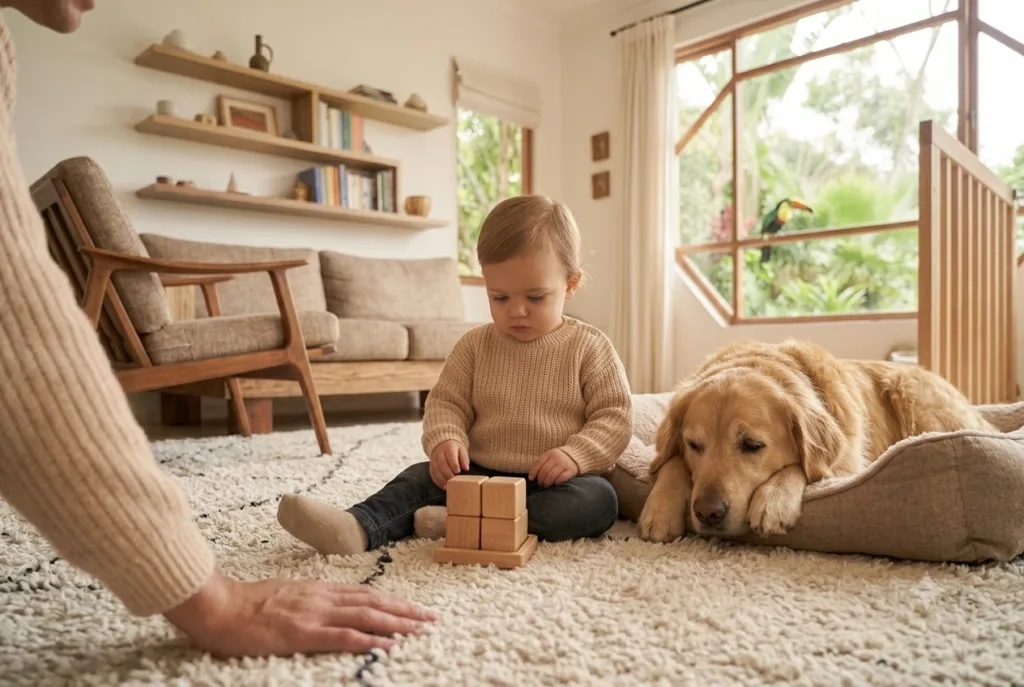
A small apartment with no separate rooms gives your dog nowhere to retreat when overwhelmed. A home with baby gates, a dedicated dog space, or multiple rooms gives everyone an exit.
The AVMA specifically recommends zoning your home so the dog and child can be separated quickly, even during short absences, rather than relying on supervision alone to prevent every incident.
Supervision Isn’t All or Nothing
One thing that changed my whole mindset: supervision exists on a spectrum, not a switch you flip on or off.
Active vs. Passive vs. No Supervision
| Level | What It Looks Like | When It’s Appropriate |
|---|---|---|
| Active | Eyes on both, hands ready to intervene | New pairings, any red flags present |
| Passive | In the same room, not staring constantly | Long, calm track record, low-risk pet |
| None | Child and dog alone, no adult present | Rarely, if ever, recommended by experts |
Most families can realistically work toward passive supervision over time. Getting to zero supervision is a much higher bar, and for very young children, most experts simply don’t recommend it at all.
When “Never” Might Be the Right Answer
This part isn’t fun to write, but it’s honest.
For children under about four, most veterinary and child-safety organizations don’t set a timeline for unsupervised time with dogs at all, they simply say it shouldn’t happen. The American Academy of Pediatrics is equally clear that a small child and a dog should never be left alone together, regardless of how well-behaved the dog is believed to be.
If your dog has any bite history, resource guarding, or unpredictable behavior, “never” may not be a phase you outgrow. It may simply be the permanent, responsible answer for that specific dog.
⚠️ This isn’t a failure. Choosing permanent supervision for a specific dog-child pairing is a responsible decision, not a sign that something is wrong with your family or your pet.
A Practical Checklist Before Reducing Supervision
Before you even consider stepping back, walk through this list honestly:
- ☐ No growling, snapping, or biting history, ever, with this child
- ☐ No resource guarding around food, toys, or resting areas
- ☐ Your dog is current on veterinary checkups and pain-free
- ☐ Your child consistently respects “gentle hands” without reminders
- ☐ Your child recognizes and respects when the dog walks away
- ☐ Your home has a safe, separate space for the dog if needed
- ☐ You’ve observed months, not days, of calm interactions
If you can’t confidently check every box, that’s your answer for now, and that’s completely okay.
Common Mistakes Parents Make
- 📅 Using age as the only factor. A calendar date doesn’t reflect temperament, history, or environment.
- 🙈 Ignoring small warning signs. A single stiff posture or lip lick is information, not an overreaction waiting to happen.
- 🏃 Stepping back too quickly after one good week. A short streak of calm behavior isn’t the same as a proven, lasting pattern.
- 🚪 Skipping the “leaving the room” plan. The AVMA specifically warns that even a short absence should mean separating the dog and child first.
FAQ About Supervision Between Toddlers and Pets
Is there really no safe age for unsupervised time?
For very young children, most veterinary and pediatric organizations don’t provide an age at which unsupervised time becomes appropriate. The guidance focuses on behavior and readiness instead of a birthday.
What if my dog has never shown any aggression?
A clean history is a good sign, but it doesn’t eliminate risk on its own. Even well-behaved, familiar family pets are involved in a significant share of dog bites to children, which is exactly why experts recommend supervision regardless of a dog’s reputation.
What does “active supervision” actually mean?
It means being close enough to physically intervene within a second or two, not simply being in the same house or half-watching from another room.
Can a trainer or behaviorist help me decide?
Yes, and I’d encourage it if you’re unsure. A qualified professional can assess your specific dog’s temperament and give you a realistic, individualized timeline instead of a generic rule.
Final Thoughts: Readiness, Not a Birthday
I stopped asking “when can I leave my toddler alone with the dog” as an age question a while ago. Now I ask it as a readiness question, and it’s checked against real evidence every time, not a calendar.
Temperament, history, size, and environment will always tell you more than a number ever could.
Temperament + History + Size + Environment = Readiness. That’s the equation I actually trust.
And if the honest answer for your family is “not yet,” or even “not ever,” that’s not a disappointment. That’s you protecting both the people and the pets you love.
Where is your family on this right now? I’d love to hear how you’re navigating it in the comments.
Sources and Further Reading
If you want to learn more about supervision, dog behavior, and safe interactions between children and dogs, these trusted resources are a great place to start:
- American Veterinary Medical Association: Preventing Dog Bites — guidance on recognizing warning signs and why supervision matters regardless of a dog’s temperament.
- American Veterinary Medical Association: Dog Bite Prevention: Plan for Success — practical advice on zoning your home and separating dogs and children when unsupervised.
- American Academy of Pediatrics: Dog Bite Prevention Tips — pediatric guidance on protecting young children around dogs, including familiar family pets.
