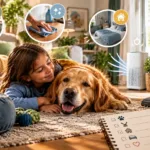
I’ll call him Leo. That is not his real name, but his family’s experience captures a change many parents recognize: a child who genuinely liked the family pet, yet resisted almost every task connected to caring for it.
At first, “pet care” meant reminders, negotiation, half-finished jobs, and a parent quietly completing the routine. Months later, Leo was the child who noticed when the water bowl was low, checked the visual schedule without being asked, and told an adult when the dog seemed different.
🐾 The change was gradual: Leo did not become responsible because someone gave him more pressure. He became more dependable after the family made the first step smaller, clearer, safer, and repeatable.
The Early Signs of Resistance
Leo loved playing with the dog. He did not love filling the water bowl, putting toys away, or stopping what he was doing to help with a routine. When an adult said, “It’s time to help with the dog,” he often answered with some version of “Why me?”
- He forgot tasks unless an adult reminded him more than once.
- He started chores but wandered away before finishing.
- He treated pet care as an interruption to play or screen time.
- He expected an adult to check everything and fix whatever was incomplete.
- He became frustrated when the pet did not respond exactly as he expected.
The Pet Was Not the Problem
Leo was not cruel or indifferent. He wanted the dog nearby and enjoyed quiet moments together. The difficulty was that he had not yet connected affection with repetitive care. Playing with an animal feels immediate. Refilling water or organizing supplies feels like work before anyone notices the result.
Why Repeated Reminders Made Things Worse
The adults’ reminders became a background soundtrack. “Did you do it?” “Go check.” “You said you would.” Each reminder made Leo feel managed, while the adults felt increasingly responsible for making him act.
The family realized they were asking him to own a responsibility before he had learned the smaller skills underneath it: remembering, starting, finishing, checking, and reporting.
The First Change: Making the Responsibility Smaller
Instead of assigning “take care of the dog,” the family chose one task: check and refill the water bowl after breakfast, with an adult nearby. The task had a clear beginning and end.
One Task, One Time of Day
The water routine was attached to something Leo already did. After breakfast, he checked the bowl. If it was low, he carried a small container with an adult and refilled it. If it was full, he marked the check card and moved on.
Helping Before Owning the Task
For several days, Leo did not do the routine independently. An adult stood beside him, narrated the steps, and made sure the dog was not crowding the bowl. The goal was familiarity, not a test of maturity.
HealthyChildren.org recommends age-appropriate tasks, clear expectations, visual reminders, consistent routines, realistic expectations, supervision, and praise for effort. Leo’s family treated those ideas as a progression rather than a single handoff of responsibility.
The Turning Point
The turning point was not dramatic. One morning, Leo noticed that the dog walked to the water area and then turned away. The bowl was empty. Before an adult said anything, Leo looked at the check card and said, “I forgot yesterday. I need to fix it.”
He did not suddenly become independent. He still needed the adult nearby. But he had begun to notice the pet’s need before a person converted it into an instruction.
The Difference Between Compliance and Care
Compliance sounds like, “I did it because you told me.” Care sounds like, “Something is different, and I should tell an adult.” The family did not expect Leo to diagnose anything. They only taught him to report changes in appetite, water, energy, bathroom habits, or behavior.
📋 The Step-by-Step Progression
Stage 1: Participating With an Adult
Leo watched an adult prepare food, refill water, organize toys, and check the dog’s space. He completed one safe movement at a time. The adult controlled portions, medication, cleaning, and decisions about health.
Stage 2: Remembering With a Visual Cue
The family placed a small card near the breakfast area with pictures for water, toys, and check-in. Leo did not have to hold the entire routine in his head. The card pointed to the next step.
Stage 3: Completing the Task With a Check-In
Next, Leo completed the simple task while an adult remained close enough to help. He then reported, “The water is done,” or “The bowl was already full.” The report was part of the job because it allowed the adult to confirm the outcome.
Stage 4: Noticing and Reporting Changes
Only after the basic routine was familiar did the family add observation. Leo learned that unusual behavior was not his problem to solve. It was information to share with an adult.
| Stage | Child’s role | Adult’s role |
|---|---|---|
| Participate | Complete one safe step | Model and supervise |
| Remember | Use the visual cue | Keep the routine consistent |
| Complete | Finish and report the task | Check the result |
| Notice | Report something unusual | Interpret and act appropriately |
What the Family Stopped Doing
They Stopped Expecting Instant Maturity
The adults stopped treating each forgotten task as evidence that Leo did not care. They treated forgetting as information: the task might be too vague, the cue might be poorly placed, or the transition might be too rushed.
They Stopped Using the Pet as a Punishment or Reward
The dog was never removed from Leo as a punishment, and access to the dog was never used as a prize. The pet remained a living family member with boundaries, rest needs, and the right to move away.
What Finally Made the Child Care
Four changes worked together:
- Predictability: the task happened at the same point in the day.
- Manageable effort: Leo was given one step before several.
- Real contribution: his help made a visible difference without making him the adult in charge.
- Connection: he began to understand what the dog’s behavior was communicating.
The pet’s response reinforced the routine too. The dog began approaching the water area after breakfast, and Leo recognized the pattern. That did not mean the dog was trained to depend on a child. It meant the family’s routine was becoming easier to notice.
Leo’s growing role was designed around those adult-protected needs.
🐾 What Responsibility Looked Like in Daily Life
| Before | After several months |
|---|---|
| Needed repeated reminders | Checked the visual routine |
| Did a task halfway | Finished the defined steps |
| Complained that care was unfair | Asked for help when a step was difficult |
| Ignored small changes | Reported unusual behavior to an adult |
| Expected the pet to play on demand | Accepted when the pet needed space |
The most meaningful change was not that Leo did more chores. It was that he started seeing the routine from the pet’s perspective: water is needed whether or not a child feels like stopping, and a tired animal should not be pulled into play.
The Timeline: How Long the Change Took
The family did not see a complete transformation in a weekend. Their rough timeline looked like this:
- Weeks 1–2: side-by-side participation and one simple task.
- Weeks 3–4: visual cues reduced the number of reminders.
- Months 2–3: Leo completed familiar tasks with an adult check-in.
- Later: the family added observation and small decisions, while adults kept responsibility for health and safety.
There were regressions during holidays, illness, travel, and schedule changes. The family responded by returning to an earlier level of support instead of treating regression as failure.
What Parents Can Replicate
Start With a Task the Child Can Actually Finish
Choose one action with a clear end: refill water with an adult, place toys in a basket, read near the pet, or help prepare a measured meal. Avoid starting with “take care of the pet.”
Track Effort Before Expecting Independence
Notice whether the child starts, continues, finishes, and reports. Independence is not the first measure of progress. A child who asks for help before making a risky guess is showing responsibility.
Increase Responsibility in Small Steps
| First | Then | Later |
|---|---|---|
| Watch an adult | Complete one step together | Complete a familiar task with a check-in |
| Use a picture cue | Use a short written list | Remember the routine with a general reminder |
| Report “done” | Report what happened | Notice and report a meaningful change |
Why This Journey May Look Different in Every Family
Responsibility develops at different speeds. A child’s age, attention, coordination, sensory needs, schedule, and emotional regulation all influence what is realistic. The pet matters too: a calm older cat has different requirements from a strong, reactive dog or an animal with a medical diet.
A family should also consider whether the task creates anxiety or competition. If a reward chart makes children fight around the pet, simplify it. If a child is afraid, begin with observation from a comfortable distance. If the animal avoids the child, create more space rather than forcing connection.
What Children Should Never Handle Alone
- Medication, supplements, or changes to a medical routine
- Special diets, portion changes, or unfamiliar foods
- Waste, bodily fluids, litter, or dangerous cleaning products
- Food guarding, aggression, fear, biting, scratching, or escape behavior
- Walking a strong or reactive animal alone
- Deciding whether an animal needs veterinary care
Food and supply handling also requires hygiene. The CDC recommends washing hands before and after handling pet food or treats and supervising children’s handwashing. An adult should decide how those steps fit the child’s age and the household’s food routine.
Common Mistakes That Slow the Process
- 📏 Assigning a large responsibility before teaching its smaller steps
- 🔁 Repeating reminders instead of improving the visual cue
- ⚖️ Comparing one child’s progress with another’s
- 😤 Treating resistance as proof that the child does not care
- 🐕 Forcing the pet to participate in order to make the task feel rewarding
- 🚫 Removing adult supervision too quickly
A Kid’s Pet Care Progress Checklist
- ☐ The child can name one safe task.
- ☐ The child can complete that task with an adult.
- ☐ The child uses a visual cue or routine reminder.
- ☐ The child finishes the task before marking it complete.
- ☐ The child reports when a step is confusing or something changes.
- ☐ The child respects the pet’s space, rest, food, and belongings.
- ☐ The adult still checks health, safety, diet, hygiene, and follow-through.
FAQ
What if my child says pet care is boring?
Keep the task short and concrete. Do not try to make every responsibility entertaining. Explain that caring for a pet includes ordinary routines, then offer a safe connection activity separately, such as reading nearby or a short structured game.
Should I use rewards?
Rewards can help establish a routine, especially when they are small, predictable, and connected to effort. They should not replace teaching, supervision, praise, or the adult’s responsibility for the animal.
When can I stop supervising?
Reduce supervision only after the child has demonstrated consistent safe behavior and the pet remains comfortable. Some tasks may become independent while others—medication, waste, strong-dog walks, or health decisions—remain adult responsibilities.
What if my child regresses?
Return to the last level that worked. Travel, illness, school changes, a new sibling, or stress can temporarily reduce a child’s capacity. Rebuilding support is not starting over; it is adapting the routine.
What if the pet does not seem interested in the child?
Do not force contact. Let the child build trust through quiet proximity, predictable care, and respecting the animal’s choice to move away. A relationship can grow without constant touching.
Final Thoughts: Responsibility Is Built in Small Moments
Leo’s journey did not begin when he suddenly decided to become responsible. It began when the adults stopped asking for an invisible, oversized change and gave him one clear action he could complete safely.
Start small → model the task → make it visible → check it → add one step at a time.
Over time, participation became routine, routine became awareness, and awareness became genuine care. The adults never stopped being responsible for the pet. They simply helped the child discover a meaningful way to contribute.
What is the smallest safe pet-care task your child could successfully complete this week?
Sources and Further Reading
These trusted resources informed the guidance on children’s chores, animal welfare, and safe pet-food handling:
- HealthyChildren.org / American Academy of Pediatrics: Age-Appropriate Chores for Children — covers visual charts, routines, age-appropriate expectations, supervision, and praise.
- Centers for Disease Control and Prevention: About Pet Food Safety — explains handwashing, safe handling, cleaning, storage, and adult supervision around pet food.

A father of three and a lifelong dog owner who started CentralUnify.com after years of figuring out — often the hard way — how to raise kids and pets who genuinely get along. Between school mornings, homework, and life with two very different dogs, Biscuit (an easygoing older lab) and Pepper (a younger terrier mix with a mind of her own), he’s learned a thing or two about keeping a busy household running without losing his sanity. When he’s not writing, he’s probably refereeing whose turn it is to feed the dogs.