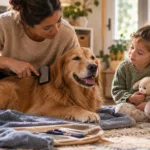
My neighbor Emma told me about the first time her daughter asked, “Can the dog come too?”
They were getting ready to visit a busy family member’s house. The toddler had been hesitant about new places for a while—loud rooms, unfamiliar adults, sudden greetings, and changes to the usual routine could make her cling tightly to Emma’s hand. No one in the family was looking for a grand solution. They were simply trying to make ordinary days feel a little easier.
But over time, the family dog became a familiar point in those moments. Not a therapist. Not a cure. Just a steady presence the child could look for, sit beside, and return to while she found her way into the rest of the day.
🐾 Sometimes a pet does not make a child’s fear disappear. Sometimes the pet gives the child a familiar place to begin.
Before the Pet Became a Comforting Presence
Emma described her daughter as a child who needed more time than some children. She liked knowing what would happen next. She watched before joining. She often stayed close to a parent when a room became noisy or an unfamiliar person moved too quickly toward her.
Small Everyday Fears Added Up
- A vacuum starting unexpectedly could send her across the room.
- A new playground sometimes required ten minutes of watching before she climbed down.
- Goodbyes at daycare could stretch when the room felt especially busy.
- Visitors were easier when they sat down and let her approach first.
- Bedtime was harder after a day with too many changes.
Emma was not describing a diagnosis or asking the dog to solve a medical problem. She was describing a child who sometimes needed a familiar anchor before trying something new.
The Family Was Not Looking for a Solution
The dog was already part of the household. He slept in his own bed, followed the family from room to room, and sometimes settled near the child while she played. His comfort came from being predictable, not from performing a special job.
The Moment They Noticed Something Was Different
One afternoon, Emma’s daughter became overwhelmed when relatives arrived earlier than expected. She stood behind Emma’s legs and watched the doorway. Then the dog walked to his mat near the sofa and lay down.
The toddler pointed toward him. Emma asked, “Would you like to sit near the dog?” She did not carry her daughter over, push her toward the animal, or ask the dog to stay still. The child walked over on her own and sat on the other side of the mat.
For a few minutes, nothing special happened. The dog rested. The child held a small book. Emma sat nearby. Then the child looked up at one of the visitors and answered a question without hiding.
The Pet Did Not Force Contact
The dog did not need to be hugged, held, or touched for the moment to help. His calm presence gave the child something familiar to watch while she decided what she was ready to do.
Familiarity Became a Starting Point
After that day, Emma began offering the dog as one possible starting point during transitions. “Would you like to sit near your book, near me, or near the dog?” The child had a choice. The dog was never presented as a requirement.
The American Academy of Pediatrics emphasizes that parents remain responsible for a child’s safety around animals and that young children should never be left alone with a pet. Emma’s approach kept the adult present and made proximity optional.
🐾 What Comfort Looked Like in Daily Life
Sitting Nearby
When the house became loud, the child could sit near the dog’s mat while Emma stayed close. The dog had room to leave, and the child had a quiet place to observe without needing to talk.
Reading or Talking Softly
Reading one short book near the dog became a familiar activity. Sometimes the child read aloud. Sometimes she turned pages silently. The point was not to make the dog listen. The point was to give the child a predictable rhythm.
Moving Through the Routine Together
On difficult mornings, Emma might say, “Let’s walk to the kitchen while the dog walks with us.” The child did not have to be brave all at once. She moved through one ordinary step with a familiar animal nearby.
The Small Rituals That Made a Difference
The Morning Check-In
Each morning, Emma’s daughter greeted the dog from a respectful distance. She might say good morning, look at his water bowl with an adult, or sit beside him for a moment. It became a gentle bridge between waking up and joining the rest of the household.
The Calm Corner
The dog’s resting area was never turned into the child’s private retreat. Instead, the family created a nearby chair with a blanket and a few books. The child could be close without entering the dog’s bed or blocking his path.
The Goodbye and Return Ritual
Before short departures, Emma used the same simple sequence: say goodbye, identify who would stay with the child, and mention when they would reconnect. The dog might be nearby, but he was not used as a promise that the child would not feel worried.
How the Adults Protected Both the Child and the Pet
The Child Was Never Allowed to Cling to the Pet
Comfort did not mean grabbing fur, climbing onto the dog, wrapping arms around his neck, or following him when he moved away. Emma showed her daughter how to offer a gentle touch only when the dog approached and remained relaxed.
The Pet Always Had an Escape Route
The dog had a mat, a quiet room, and a clear path away from the child. A gate was used when the family could not actively supervise. The child learned that the dog’s bed was a “resting place,” not a place to visit whenever she wanted contact.
Adults Stayed Involved
Emma remained the person who helped her daughter name the feeling, choose a next step, and decide when to stop. The dog was not expected to calm the child, tolerate unlimited touch, or stay available during every difficult moment.
The ASPCA recommends supervising interactions, teaching children to respect a dog’s body and belongings, and providing safe zones where the dog can retreat. Those boundaries made the child’s connection safer and more sustainable.
📋 A Simple Comfort Routine Other Families Can Adapt
| Step | What the adult can do | What the child can choose |
|---|---|---|
| Notice | Name that the moment feels big or unfamiliar | Stay close to the adult |
| Offer | Present two calm options | Sit near the pet or choose another safe spot |
| Wait | Keep the pet and child separated enough to relax | Look, read, breathe, or hold a comfort object |
| Continue | Invite the next small step without pressure | Join the activity when ready |
This routine is not a treatment plan. It is simply a gentle way to offer predictability during ordinary transitions. If the child chooses not to be near the pet, that choice is completely acceptable.
What Changed—and What Did Not
The Child Began Recovering Faster
Emma noticed that her daughter sometimes returned to an activity more quickly after sitting near the dog. She could watch the room, hold her book, and decide when to participate. The difficult moment became shorter on some days.
The Child Still Had Hard Days
There were still loud mornings, clingy goodbyes, and visits when the child wanted to leave early. The dog did not make every situation easy. He simply became one familiar part of a larger support system that included parents, routines, words, rest, and time.
The Pet Remained a Pet
Some days the dog wanted to nap elsewhere. Some days he was playful. Some days he walked away from the child’s chair. The family treated those choices as normal communication, not as rejection or failure.
Why Familiar Presence Can Feel So Powerful to a Young Child
A familiar pet brings recognizable sounds, smells, movements, and routines into a moment that otherwise feels new. A child may know where the dog rests, how the dog walks, and what usually happens next. That predictability can make it easier to pause and observe.
That does not mean every child will respond this way, or that a pet should be introduced as a solution for fear. It simply explains why a familiar presence can become meaningful in a family’s everyday rhythm.
What Parents Can Borrow From This Story
Create Calm Proximity, Not Forced Contact
Let the child and pet share space without requiring petting, eye contact, cuddling, or play. The child can read, draw, or hold a blanket while the pet rests nearby.
Give the Child a Predictable Choice
Offer two safe choices rather than asking an overwhelmed child to invent a solution: “Would you like to sit in the chair near the dog, or sit with me by the window?”
Keep the Ritual Short
A two-minute ritual can be enough. Stop before the child becomes frustrated or the pet becomes tired. Repetition matters more than length.
When Comfort Should Not Depend on the Pet
A child needs human adults who can listen, comfort, set limits, and make decisions. The pet cannot carry that role. Do not leave a toddler alone with an animal because the animal seems gentle or because the child appears calm.
If fear is persistent, intense, prevents ordinary activities, or is accompanied by major changes in sleep, eating, communication, or daily functioning, discuss it with the child’s pediatrician. The pet can remain part of the family’s comfort routine, but it should not delay appropriate support.
Common Mistakes Families Make
- 🤗 Forcing the child to hug or pet the animal
- 🐕 Holding the pet in place so the child can feel better
- 🚪 Blocking the pet’s route to its bed or quiet area
- 🩹 Treating the pet as a replacement for adult reassurance
- 📸 Turning every difficult moment into a lesson about bravery
- 🙈 Ignoring signs that the pet is tired, tense, or trying to leave
A Gentle Pet-and-Toddler Comfort Checklist
- ☐ An adult supervises every interaction.
- ☐ The child can choose proximity without forced touch.
- ☐ The pet has a quiet area and a clear escape route.
- ☐ The child is not allowed to disturb the pet while eating or sleeping.
- ☐ The ritual is short, calm, and predictable.
- ☐ Adults provide comfort and do not make the pet responsible for the child’s emotions.
- ☐ Hands are washed after touching the pet, food, bowls, or toys.
The CDC recommends handwashing after touching, feeding, or playing with pets and after handling pet food, bowls, toys, or other animal equipment. For toddlers, an adult should help make that step part of the routine.
FAQ
Should my toddler hug the pet for comfort?
No. A hug can feel restrictive or frightening to an animal. Offer sitting nearby, gentle touch only when the pet approaches, or a comfort object held by the child.
What if the pet walks away?
Let the pet leave. Tell the child, “The dog is taking a break.” Then offer another safe place to sit or another calming activity. Walking away is useful communication.
Can my child sleep with the pet?
Follow your household’s sleep-safety and pet-safety rules. A toddler should not be left unsupervised with a pet during sleep, and the animal should always have a separate comfortable place to rest.
What if the child’s fear continues?
Continue offering calm adult support without forcing exposure. If fear is intense, persistent, or interferes with everyday life, speak with the child’s pediatrician. A pet can be comforting without being the entire plan.
What if the pet seems uncomfortable around the toddler?
Increase distance immediately, use a gate or separate space, and stop the interaction. Do not ask the pet to tolerate more contact. If discomfort continues, consult a veterinarian or qualified behavior professional.
Final Thoughts: A Safe Place to Begin
Emma’s daughter did not become fearless because of the dog. She became a little more willing to pause, observe, and try the next small step when a familiar presence was nearby.
Offer choice. Keep the moment calm. Protect the pet’s boundaries. Let the child move at a manageable pace.
Sometimes the most helpful thing a pet brings to a difficult moment is not a solution. It is a familiar sound in the room, a warm body resting nearby, or a reason to sit still long enough for a child to feel ready.
Has your child ever found comfort in simply being near a family pet during a new or difficult moment?
Sources and Further Reading
These trusted resources informed the guidance on toddler safety, supervised interaction, pet boundaries, and hygiene:
- HealthyChildren.org / American Academy of Pediatrics: How to Choose the Right Pet for Your Family — covers adult responsibility, supervision, gentle handling, and preventing bites.
- ASPCA: Dogs and Babies — explains safe zones, retreat options, respectful child interaction, and active supervision.
- Centers for Disease Control and Prevention: Hygiene Practices Around Animals — provides guidance on handwashing after contact with pets and pet supplies.

A father of three and a lifelong dog owner who started CentralUnify.com after years of figuring out — often the hard way — how to raise kids and pets who genuinely get along. Between school mornings, homework, and life with two very different dogs, Biscuit (an easygoing older lab) and Pepper (a younger terrier mix with a mind of her own), he’s learned a thing or two about keeping a busy household running without losing his sanity. When he’s not writing, he’s probably refereeing whose turn it is to feed the dogs.