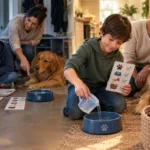
A friend of mine remarried two years ago. She spent months preparing her kids for the move, the new house, the new siblings. Nobody, including her, thought much about the fact that two cats and a dog were also about to become one household.
“It honestly caught us off guard,” she told me. “We had a whole plan for the kids and zero plan for the pets.” Combining households with pets turned out to be its own transition entirely, one that almost no blended family resource actually covers.
🐾 The basic idea: Merging two households means merging two sets of pets, two sets of routines, and kids with different attachments to each animal. Treat it as its own transition, not an afterthought to the family side of the move.
Why This Situation Gets So Little Attention
Search for advice on introducing a new pet, and you’ll find plenty. Search for advice on combining two entire pet households during a remarriage, and the results thin out fast.
🏠 One New Pet vs. Two Full Households Merging
Bringing home a single new puppy or kitten is disruptive, but it’s a known, well-documented process. Combining two households means every pet loses something familiar at once: their space, their routine, and often the amount of attention they’re used to getting from “their” adult.
Layer in kids from both sides who each have their own bond with a specific pet, and you’ve got a far more complex situation than a typical introduction guide accounts for.
The Unique Challenges of Combining Two Pet Families
Combining households with pets brings a specific set of challenges that a single new-pet introduction simply doesn’t cover.
Pets Losing “Their” Adult’s Full Attention
A pet who’s had one adult’s undivided attention for years suddenly has to share that person, and the house, with an entirely new family. Some pets adjust with barely a hiccup. Others become noticeably clingier, more anxious, or withdrawn.
Kids With Different Bonds to Each Pet
One child might have grown up with the family dog since birth. Another might be meeting that same dog for the first time as a near-stranger. Expecting instant, equal affection from every child toward every pet sets everyone up for disappointment.
Territorial Friction Between the Pets Themselves
The ASPCA explains that territorial aggression often appears when unfamiliar animals enter a dog’s established home turf, and that this tendency shows up regardless of how friendly a dog has been in other settings. Two previously “only pets” suddenly sharing one house is exactly the kind of scenario that can trigger it.
Preparing the Transition Before the Physical Move
Gradual Scent Swapping Between the Pets
Before the animals ever meet, swap blankets, toys, or bedding between the two households so each pet becomes familiar with the other’s scent in a low-pressure way. This single step does a surprising amount of the early groundwork.
Talking to the Kids About Expectations
Just as children need preparation for new stepsiblings, they need the same honest conversation about the pets. Explain that the animals might need time, that hissing or growling at first doesn’t mean anything is “wrong,” and that forcing affection from either side usually backfires.
The American Academy of Pediatrics notes that children adjust better to a blended family when they feel included in the process rather than having changes simply happen to them. The same principle applies directly to how they experience the pets adjusting too.
💡 Prep both sides equally. The pets need scent and space prep. The kids need honest, age-appropriate conversation. Skipping either one makes the whole transition harder.
The First Week: Managing Territory and Routine
Keep each pet’s core routine as intact as possible in the new shared space: same feeding times, same bed, same walk schedule, just now happening under one roof.
- 🍽️ Feed pets in separate areas initially, even after they seem comfortable together
- 🛏️ Give each pet a designated “own” space they don’t have to share right away
- 🚪 Use baby gates or separate rooms for supervised introductions rather than a single all-at-once meeting
Resist the urge to force a “happy family photo” moment in week one. Slow, uneventful progress is a genuinely good sign here.
Signs the Adjustment Isn’t Going Well
| 🐾 Sign | What It May Indicate |
|---|---|
| Ongoing growling or hissing beyond the first couple weeks | Territorial tension hasn’t eased |
| A pet hiding constantly or refusing to eat | Chronic stress needing intervention |
| Escalating fights rather than settling disputes | Introductions moved too fast |
| A child becoming afraid of a previously friendly pet | The pet may be redirecting stress toward the newest, least familiar family member |
When Pets Simply Won’t Get Along
Sometimes, despite every reasonable effort, two pets don’t reach genuine peace, only an uneasy truce maintained through permanent separation. That’s a real, valid outcome, not a failure on your part.
Managing a home with a permanent gate between two pets, or keeping them on separate schedules indefinitely, is a legitimate long-term solution when full integration doesn’t happen.
Common Mistakes During This Transition
- 🏃 Combining everything on moving day itself. Pets and kids both need time to adjust to the house before meeting each other.
- ⚖️ Expecting equal affection from every child for every pet immediately. Bonds take time to build, especially for kids meeting an unfamiliar animal.
- 🙅 Punishing normal territorial displays as if they were random aggression. Understanding the root cause changes how you respond.
- 📸 Rushing toward the “one big happy family” milestone. A slower, uneventful adjustment beats a fast, tense one.
FAQ About Combining Households With Pets
How long does it typically take for pets to adjust to a blended household?
Many pets show meaningful improvement within a few weeks, though full comfort can take a few months, similar to the multi-year adjustment timeline often cited for the human side of blended families.
Should kids from each side be responsible for “their own” pet during the transition?
Keeping some individual responsibility intact at first can actually ease the transition, giving kids a familiar role rather than suddenly sharing every pet-care task with new stepsiblings right away.
What if one pet was an “only pet” for years before the merge?
Give that pet extra one-on-one time and a protected space, since the sudden loss of exclusive attention and territory tends to hit these pets hardest.
Is it normal for the dynamic to change again months later?
Yes. Pets, like people in blended families, can hit new friction points as routines shift further, especially around big changes like a new school year or a pet aging into a different life stage.
Final Thoughts: Give the Pets Their Own Transition
My friend’s household eventually settled, dogs and cats included, but only once she stopped treating the pets as a footnote to the family transition and started treating their adjustment as its own real process.
Prep scent and space early → keep routines intact → let bonds build at their own pace → accept that “peaceful coexistence” is a real win. That’s the whole approach.
Combining households with pets deserves the same patience and planning as combining the rest of the family, because for a lot of kids, that family bond starts with the pet long before it starts with the new stepsibling down the hall.
Has your family gone through this kind of merge? I’d love to hear how the pets handled it in the comments.
Sources and Further Reading
If you want to learn more about pet territorial behavior and helping children adjust to a blended family, these trusted resources are a great place to start:
- ASPCA: Aggression — a detailed breakdown of territorial and social aggression in dogs, including what triggers it.
- American Academy of Pediatrics / HealthyChildren.org: Becoming a Stepfamily — guidance on helping children adjust to a new blended household.

A father of three and a lifelong dog owner who started CentralUnify.com after years of figuring out — often the hard way — how to raise kids and pets who genuinely get along. Between school mornings, homework, and life with two very different dogs, Biscuit (an easygoing older lab) and Pepper (a younger terrier mix with a mind of her own), he’s learned a thing or two about keeping a busy household running without losing his sanity. When he’s not writing, he’s probably refereeing whose turn it is to feed the dogs.