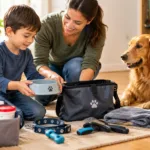
Sleeping pets can look especially inviting to young children. A child may want to stroke the animal, whisper to it, wake it for play, or lie beside it because the pet appears calm and approachable. The quiet moment can feel harmless, but a sleeping animal may wake suddenly, become disoriented, or react defensively when touched.
Teaching children about children disturbing sleeping pets is not about making the pet seem frightening. It is about teaching a simple difference: observing a sleeping animal is allowed from a respectful distance; waking, touching, hugging, climbing on, or lying over the animal is not.
🐾 The central rule: Sleeping pets are not available for play. Wait until the animal wakes and an adult says the interaction is appropriate.
Observing Is Different From Waking
Children can learn that looking is not the same as touching. An adult might say, “You can see the pet sleeping, but your hands stay with you and your body stays off the pet.” This gives the child something they can do instead of simply hearing “no.”
| 👀 Child’s action | Safe or unsafe? | What to teach |
|---|---|---|
| Looks quietly from a short distance | Usually safe with supervision | Use eyes, not hands |
| Whispers close to the pet | Not recommended | Sound can startle the animal; step back |
| Touches or strokes the sleeping pet | Unsafe | Wait until the pet wakes |
| Calls the pet repeatedly | May disturb rest | Let the animal wake naturally |
| Lies beside, leans on, or climbs over the pet | Unsafe | Keep the child’s body off the animal |
| Notices the pet waking | Adult-guided moment | Stay still and wait for direction |
Why Waking a Pet Can Be Risky
A sleeping animal may not immediately understand what touched it or where the child’s face and hands are. A sudden touch, poke, hug, or weight on the body can trigger a startle response. The risk is higher when the pet is elderly, in pain, sick, deaf, visually impaired, or deeply asleep.
The AVMA’s dog-bite prevention guidance specifically says never to disturb a sleeping dog. The recommendation is dog-specific, but the prevention principle is sensible for any pet: do not create a surprise interaction while the animal is asleep.
Teach a Three-Step Sleep Rule
Use the same short sequence every time the child approaches a sleeping pet. Repetition is more useful than a long explanation delivered after the child has already touched the animal.
- 🛑 Stop: freeze your feet before getting close.
- 👀 Look: observe quietly from a distance.
- ⏳ Wait: let the pet wake on its own and ask an adult before touching.
A memorable phrase can help: “Sleeping pet, quiet feet.” For a toddler, pair the phrase with a visual gesture: one finger to the lips, hands folded together, and two feet staying behind a floor marker.
Make “Do Not Lie on the Pet” Completely Clear
Some children treat a sleeping dog or cat like a soft cushion or stuffed animal. State the physical boundary directly: no sitting, lying, leaning, hugging, stepping over, or placing a face close to the sleeping pet.
- 🚫 Never lie on the pet, even gently.
- 🚫 Never place a blanket, pillow, or stuffed toy over the pet.
- 🚫 Never put a face near the pet’s face to wake it.
- 🚫 Never pull a paw, tail, ear, collar, or blanket.
- 🚫 Never wake the pet to take a photo or start a game.
If the child climbs onto the animal, move the child away calmly and immediately. Do not wait to see whether the pet tolerates it. Young children must never be left alone with an animal.
Teach What to Do When the Pet Starts Waking
Waking is a transition, not an invitation to rush in. A pet may stretch, twitch, open its eyes, change position, or stand up without being ready for touch. Teach the child to remain still and let the adult decide what happens next.
- 🐾 Keep hands away while the pet opens its eyes.
- 🧍 Keep the child’s face and body at a distance.
- 📣 Ask, “Is the pet awake?” instead of reaching.
- ✅ Wait for an adult to invite calm contact.
- 🚶 Stop if the pet moves away or does not approach.
When the pet is fully awake, call it toward the child rather than having the child approach a resting animal. If the pet does not come, the answer is no for that moment.
Use Supervision and Simple Physical Boundaries
Words are not enough for a toddler who cannot reliably stop an impulse. An adult should stay close during periods when the pet sleeps, especially if the animal rests on a sofa, bed, floor cushion, or other place the child can reach.
A low gate, closed door, crib-style play area, or separate piece of furniture can create distance while allowing the pet to rest without being touched. The purpose is to prevent accidental waking, not to force the pet into a particular sleeping location.
Blue Cross advises letting puppies sleep undisturbed and using supervision and barriers when children and puppies cannot be watched closely. Puppies may become irritable or defensive when they are repeatedly startled or woken.
Give the Child a Quiet Alternative
A child may approach a sleeping pet because the room feels quiet or because the child wants a calm activity. Offer a replacement that keeps the child engaged without making the pet responsible for the child’s entertainment.
- 📚 Read a book about animals nearby without touching the pet.
- 🎨 Draw the pet sleeping and add details after the animal wakes.
- 🧩 Complete a quiet puzzle or building activity in another area.
- 🎥 Watch a short animal video with an adult.
- 📝 Make a “sleeping pet” sign with pictures to practice the rule.
- ⏰ Choose a later time to play when the pet is naturally awake.
Cat-Specific Sleep Lessons
Cats may sleep in unexpected places, including laps, chairs, beds, shelves, or open areas. A child may assume that a cat sleeping on a person is available for stroking. Teach the same rule: if the cat is asleep, hands stay away until the cat wakes and an adult confirms that contact is appropriate.
Cats Protection explains that cats should not be disturbed while sleeping because a sleepy or disoriented cat may react defensively to a perceived threat. Its guidance also notes that cats need substantial sleep, including more rest during kittenhood and older age.
Recognize When an Adult Must Intervene Immediately
- 🚨 The child reaches for, pokes, pulls, hugs, or lies on the sleeping pet.
- 🚨 The child puts a face close to the animal’s face.
- 🚨 The child repeatedly calls or shakes an object to wake the pet.
- 🚨 The pet wakes suddenly, startles, vocalizes, swats, snaps, or tries to escape.
- 🚨 The child cannot stop after one calm instruction.
- 🚨 The pet is old, sick, injured, deaf, visually impaired, or recovering.
Move the child away first, then allow the pet to wake and move without being followed. Do not punish the animal for startling or warning. If a pet repeatedly reacts strongly when awakened, ask a veterinarian about pain, hearing, vision, sleep, or behavior concerns.
Family Checklist for Sleeping Pets
- ☐ Does every child know that sleeping means no touching?
- ☐ Does everyone know that lying on or over the pet is never allowed?
- ☐ Is an adult close enough to interrupt quickly?
- ☐ Are barriers available when a toddler cannot control impulses?
- ☐ Does the child have a quiet alternative activity?
- ☐ Does the family wait for the pet to wake naturally?
- ☐ Does an adult decide whether the awake pet wants contact?
FAQ About Children Disturbing Sleeping Pets
Can a child quietly pet a sleeping pet?
No. Quiet hands can still startle an animal. Teach the child to observe without touching and wait until the pet is awake.
What if the pet sleeps on the child’s lap?
The child should remain still and call an adult if they need to move. The child should not stroke, squeeze, reposition, or lift the sleeping pet without help.
Is it okay to wake the pet for a photo?
No. Take a photo from a respectful distance if the animal is already resting peacefully, but never touch or wake the pet to create a picture.
Final Thoughts: Let Sleeping Pets Rest
Children can learn to appreciate a sleeping pet without turning rest into an invitation. Observe from a distance, keep hands and bodies away, wait for natural waking, and let an adult guide any later contact.
When children disturb sleeping pets, the safest response is calm and immediate: move the child, protect the animal’s rest, and repeat the rule that sleep is not playtime.
What quiet activity helps your child wait while the pet sleeps? Share what has worked for your family in the comments.
Sources and Further Reading
- American Veterinary Medical Association: Dog Bite Prevention — dog-specific guidance not to disturb sleeping dogs and to supervise children.
- Cats Protection: Cats and Sleep — cat-specific guidance on sleep, waking, and avoiding disturbance.
- Blue Cross: Puppies and Children — guidance on letting puppies sleep undisturbed, supervision, and barriers.
- HealthyChildren.org: How to Choose the Right Pet for Your Family — pediatric guidance on teaching children not to disturb animals while sleeping or eating.

A father of three and a lifelong dog owner who started CentralUnify.com after years of figuring out — often the hard way — how to raise kids and pets who genuinely get along. Between school mornings, homework, and life with two very different dogs, Biscuit (an easygoing older lab) and Pepper (a younger terrier mix with a mind of her own), he’s learned a thing or two about keeping a busy household running without losing his sanity. When he’s not writing, he’s probably refereeing whose turn it is to feed the dogs.