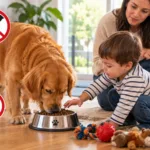
For a child who wants to help with the family pet, gathering a few approved supplies can be a small, concrete way to participate. It is a preparation task—not permission to choose the pet’s care, open storage, or start handling the animal without an adult.
The adult should define the task and name the safe items before the child begins. A child might bring a clean bowl, an unopened waste bag, a brush, or a towel from an accessible, adult-approved spot. Medication, cleaning products, sharp tools, restraint equipment, and other risky items remain under adult control.
🐾 Central idea: The child gathers only the named, safe items and waits for the adult’s check before care begins.
Why Prepare Supplies Before the Task?
Preparing first gives the child a clear beginning and endpoint: hear the adult’s instruction, gather a few approved items, place them at a designated spot, and report back. That is different from asking a child to “take care of the pet,” which can leave them guessing about products, portions, handling, or what to do if something is missing.
The role stays deliberately narrow. The adult selects the task, checks that the supplies suit that animal, and remains responsible for the outcome. If the child is not ready to retrieve items safely, they can point to them on a picture list or watch while the adult prepares.
| Supply | Child’s preparation role | Adult checks |
|---|---|---|
| Clean bowl | Carry it to the agreed spot | Whether it is the right bowl and ready to use |
| Brush | Bring the named, approved brush | Whether the pet is comfortable and the brush is suitable |
| Clean towel | Set it on a clean surface | Whether it is needed for this task |
| Unopened waste bag | Bring one unopened bag, if asked | Whether an adult will handle cleanup |
These are examples, not a universal kit. The right items depend on the pet and activity. The adult can also use this pause to make sure the pet is comfortable and the activity still makes sense. If the animal is resting, ill, injured, frightened, unusually excited, or hard to control, postpone or separate the child and pet.
A Five-Step Prepare-and-Check Routine
Teach the setup away from the pet first, then repeat it for one familiar, low-risk task:
- Name the task. The adult explains what is happening, such as bringing supplies for an adult-led brushing.
- Name each item and its location. “Bring the clean towel and soft brush from this shelf” is clearer than “get everything.”
- Use an approved storage spot. The child does not search cabinets, open containers, or enter the pet’s feeding or resting area.
- Set supplies down where the adult directs. Use a stable, clean surface—not the pet’s bed or a spot where the animal could chew or swallow an item.
- Wait for the adult check. The adult confirms that the items are clean, appropriate, complete, and safe before care begins.
For example, before an adult brushes a cooperative pet, a child may bring the approved brush and a clean towel, then wait. The child does not start brushing just because the tools are ready; the adult decides whether to proceed and controls the handling.
Choose Items for the Task—Not by Guesswork
There is no universal supply kit for every pet or household. The adult chooses materials based on the animal’s needs, the task, product directions, and veterinary instructions. The child retrieves only what was named; they do not substitute, measure, mix, or decide that more is needed.
Choose clean, intact items that are easy for the child to carry. Avoid objects that are sharp, heavy, breakable, electrical, or small enough to be swallowed. Keep the pet at a comfortable distance while the child gathers supplies; do not ask the child to lure, hold, chase, or reposition the animal.
Food and feeding equipment need extra care. An adult determines the food, amount, and feeding plan, especially for a pet on a special diet. The CDC recommends washing hands with soap and water before and after handling pet food or treats. Adults should supervise children to ensure they wash their hands properly.
Adult Responsibilities and Stop Points
The child may: carry a small, clean item from an approved place; match safe supplies to a picture or written list; set them down where directed; and tell an adult if something is missing, dirty, damaged, or unfamiliar. Participation should fit the child’s coordination, attention, and ability to follow directions—not age alone.
The adult must: choose and inspect supplies, control storage, follow product and veterinary directions, supervise any contact with the pet, and make decisions about feeding, medication, restraint, transport, illness, injury, and emergencies. A checklist supports a routine; it does not transfer responsibility for the pet’s care.
Keep medications, supplements, cleaning products, pesticides, sharp grooming tools, and potentially injurious equipment in secure adult-controlled storage. Do not ask a child to retrieve, open, measure, or apply them—even after watching an adult. The AVMA recommends secure storage and following label directions for household cleaners; medication decisions should be made with a veterinarian.
Stop the preparation or care if the child reaches for an unapproved item, cannot follow the instruction, becomes upset or overexcited, or tries to approach or move the pet. Stop if the animal moves away, seems distressed, or becomes difficult to control. An adult should put supplies away, create space, and decide whether to try another time. For injury, illness, pain, aggression, or a sudden behavior change, contact a veterinarian or qualified professional.
Quick Checklist: Is the Setup Ready?
Before the pet-care activity starts, an adult can run through these checks with the child:
- ☐ The task and each supply were named by an adult.
- ☐ The child used only the approved storage spot and items.
- ☐ Supplies are clean, intact, and set down in the agreed place.
- ☐ Medication, cleaners, sharp tools, and risky equipment stayed with the adult.
- ☐ The pet has room to move away, and an adult can intervene immediately.
- ☐ The child knows to stop and ask if something is missing or different.
If a supply is contaminated, damaged, unfamiliar, or stored somewhere the child cannot safely reach, the adult takes over. If either the child or pet is tired, uncomfortable, or distracted, pause and try later. The goal is a calm, supervised setup—not completing a chore at any cost.
Final Thoughts
Preparing supplies can be a useful, bounded way for a child to contribute before pet care. The adult defines the task, chooses safe materials, checks the setup, supervises the interaction, and remains responsible for the pet. The child’s part is simple: gather only the approved items, place them where directed, and ask for help when the plan changes.
Sources and Further Reading
- Centers for Disease Control and Prevention: About Pet Food Safety — guidance on handling pet food and treats and supervising children’s handwashing.
- American Veterinary Medical Association: Pet Ownership — ongoing care and welfare responsibilities of pet owners.
- American Veterinary Medical Association: Household Hazards — safe storage and handling of medications, cleaning products, and other household hazards around pets.

A father of three and a lifelong dog owner who started CentralUnify.com after years of figuring out — often the hard way — how to raise kids and pets who genuinely get along. Between school mornings, homework, and life with two very different dogs, Biscuit (an easygoing older lab) and Pepper (a younger terrier mix with a mind of her own), he’s learned a thing or two about keeping a busy household running without losing his sanity. When he’s not writing, he’s probably refereeing whose turn it is to feed the dogs.