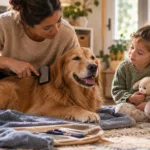
The toddler was only reaching for the dog’s collar, but the dog’s entire body had already changed. Her ears had moved back, her mouth had closed, and the whites of her eyes showed for just a second.
Her parent almost missed it because the dog did not growl. She did not snap. She simply became very still while the child leaned closer.
That is why learning to recognize dog stress signals around toddlers matters so much. The most useful warning may appear before a dramatic sound or movement, while an adult still has time to calmly change the situation.
🐾 The basic idea: A stressed dog is communicating before the situation becomes dangerous. Watch the whole body, create distance early, and never make a toddler continue an interaction just because the dog has not growled.
Why Stress Signals Matter Around Toddlers
Toddlers are curious, quick, and still learning how another living creature feels. They may follow a dog under a table, touch a sleeping dog, hug too tightly, or keep reaching after the dog has turned away.
The American Academy of Pediatrics emphasizes that young children should never be left alone with an animal and that adults are responsible for managing the interaction. A toddler may not recognize that a rigid body, a stare, or a retreat means “please give me space.”
That responsibility belongs to the adult. The goal is not to make the child responsible for decoding every canine signal. The goal is to notice early changes and step in before the dog feels cornered.
5 Warning Signs Your Dog Is Stressed Around Your Toddler
1. Ears Pulled Back or Pinned Down 👂
A dog’s ears can move for many reasons, and some breeds naturally carry their ears differently. The important clue is a change from your dog’s normal position, especially when the ears are pulled tightly backward along with a tense face, lowered head, tucked tail, or lip licking.
Example: Your toddler walks toward the dog’s bed holding a toy. The dog’s ears shift back, the head lowers, and the dog stops looking loose.
What to do: Calmly guide the toddler away and give the dog a clear escape route. Do not ask the child to reach more slowly, pet the dog one more time, or “see if he is okay.”
2. Lip Licking or Repeated Nose Licking 👅
A dog may lick its lips after eating, smelling food, or taking a treat. A quick tongue flick in a tense moment means something different, particularly when there is no food nearby and the child is moving closer.
The ASPCApro canine body-language guide identifies lip licking and yawning as possible early stress signals, especially when they appear with a tight mouth or averted gaze.
Example: Your toddler leans over the dog while saying, “Kiss!” The dog licks its nose several times, closes its mouth, and turns its head away.
What to do: Interrupt the face-to-face contact immediately. Move the toddler back, praise the dog for moving away if appropriate, and avoid encouraging kisses or close face contact.
3. “Whale Eye” or Showing the Whites of the Eyes 👀
Whale eye is the common term for a dog showing a noticeable crescent or slice of white around the eye. It often appears when the dog turns its head away but keeps watching the child, a toy, food, or another object.
This does not mean every visible white area is automatically dangerous. Look at the whole dog: tight facial muscles, a frozen body, pinned ears, a closed mouth, or a tense tail make the message more urgent. The American Kennel Club explains that whale eye can signal anxiety or stress and should be interpreted with the rest of the dog’s body language.
Example: Your toddler tries to take a chew from the dog. The dog looks sideways without moving its head, and a large crescent of white appears.
What to do: Do not let the child reach for the chew. Use a barrier or call the child away, then let the dog keep its space. Never teach a toddler to “test” whether the dog will tolerate a toy being removed.
4. A Stiff, Frozen, or Rigid Body 🧍
Many parents mistake stillness for calm. A relaxed dog usually looks loose and able to move naturally. A stressed dog may freeze, hold its muscles rigid, shift its weight, or become unusually slow and quiet.
Example: The toddler places both hands on the dog’s back. The dog stops wagging, closes its mouth, stiffens its legs, and stares toward the adult.
What to do: Treat the freeze as a request for space. Calmly remove the toddler from the dog rather than touching or pulling the dog. A dog that cannot move away may eventually use a louder warning.
5. Avoiding Contact or Trying to Leave 🚪
Turning away, walking out of the room, hiding behind furniture, leaning away, sniffing the floor, or repeatedly seeking an exit can all be attempts to reduce pressure. Avoidance is not rudeness. It is useful information.
Example: Every time the toddler enters the room, the dog gets up and moves behind the sofa. The child follows, laughing, because the movement feels like a game.
What to do: Stop the chase. Keep the child away from the dog’s retreat and create a child-free area where the dog can rest without being followed.
💡 Avoidance is a successful warning. If the dog walks away, let the dog leave. The adult’s job is to make retreat possible before the dog feels forced to defend itself.
What the Five Signs May Be Telling You
| Signal | Possible context | First response |
|---|---|---|
| Ears pulled back | The toddler is approaching, reaching, or making sudden noise | Increase distance and lower the activity level |
| Lip licking | The child is leaning over, hugging, staring, or touching repeatedly | End the contact and give the dog a break |
| Whale eye | The child is near food, toys, a resting spot, or the dog’s body | Move the child away without taking the item from the dog |
| Rigid body | The dog feels trapped, startled, or unable to leave | Separate calmly and open an escape route |
| Avoiding contact | The dog is overwhelmed or asking for distance | Stop the chase and protect the retreat |
One signal can be easy to misread. Several signals appearing together, or a sudden change from your dog’s normal behavior, deserve a faster response.
What to Do the Moment You Notice Stress
Move the Toddler, Not the Dog
Use a calm voice and guide the toddler toward another activity. Avoid yelling, grabbing the dog by the collar, or creating a frantic struggle in a small space.
Give the Dog a Real Retreat
A retreat can be a gated room, crate, bed behind a barrier, elevated platform, or quiet corner that the toddler cannot enter. The ASPCA recommends teaching dogs that moving away is an option and creating safe zones where children cannot follow.
Do Not Punish the Warning
Do not punish lip licking, hiding, freezing, growling, or other warning behavior. Punishment may make the dog associate the child with something unpleasant and may suppress a warning without removing the fear underneath it.
Change the Setup Before Expecting Better Behavior
- 🛋️ Move the dog’s bed away from busy toddler pathways.
- 🚪 Use gates during meals, naps, visitors, and high-energy play.
- 🧸 Keep chews, food bowls, and favorite toys away from the child’s reach.
- 👀 Stay close enough to intervene before the toddler reaches the dog.
- 🌙 Protect quiet sleep and uninterrupted rest.
What Not to Do When Your Dog Looks Stressed
- 🚫 Do not force a greeting. A dog does not need to accept a hug, kiss, or toddler touch.
- 🚫 Do not say “he’s fine” and continue. The absence of a growl does not prove that the dog is comfortable.
- 🚫 Do not let the child chase the dog. Repeated retreat can become panic when the dog cannot find space.
- 🚫 Do not punish a growl. Treat it as information and create distance immediately.
- 🚫 Do not leave them together unsupervised. Even a familiar, gentle dog can react when startled, hurt, or cornered.
When Stress Becomes a Safety Concern
Stress signals do not automatically mean that a dog is dangerous. They do mean that the current interaction or environment needs to change. The concern becomes more urgent when the dog cannot get away, the child keeps ignoring adult direction, or the signals intensify.
Separate Immediately for These Signs
- ⚠️ Growling, snarling, snapping, or showing teeth
- ⚠️ A bite, attempted bite, or contact that injures the child
- ⚠️ Repeated freezing or staring when the toddler approaches
- ⚠️ Guarding food, toys, furniture, or a person
- ⚠️ A history of aggression or predatory behavior around children
Keep the child and dog separated and contact a veterinarian or qualified behavior professional. If there has been a bite or injury, seek appropriate medical care for the child and veterinary guidance for the dog.
Look Beyond “Training”
A sudden behavior change can be related to pain or illness, not only a difficult toddler interaction. A veterinary evaluation is especially important when stress appears with appetite changes, unusual fatigue, sensitivity to touch, sleep disruption, or other physical symptoms.
A Quick Parent Checklist
- ☐ I know what my dog’s relaxed body language normally looks like.
- ☐ I watch the whole body instead of relying on the tail or mouth alone.
- ☐ My toddler cannot enter the dog’s retreat.
- ☐ I interrupt chasing, hugging, climbing, and face-to-face contact.
- ☐ I move the toddler away when the dog turns away or tries to leave.
- ☐ I do not punish warning signals.
- ☐ I know which behavior changes require a veterinary or professional call.
FAQ About Dog Stress Signals Around Toddlers
Does a wagging tail mean the dog is comfortable?
Not necessarily. A loose, broad wag with relaxed movement can support a comfortable reading, but a high, stiff, fast, or low wag may reflect arousal or uncertainty. Always consider the ears, eyes, mouth, posture, and situation together.
Is lip licking always a stress signal?
No. Dogs may lick their lips after food or treats. It becomes more meaningful when it appears suddenly during a toddler interaction, especially with yawning, averted eyes, pinned ears, or a tense body.
Should I tell my toddler to stop if the dog walks away?
Yes. The dog’s retreat should end the interaction. Use a simple phrase such as, “The dog needs space,” and redirect the child without turning the moment into a punishment.
What if my dog has never shown aggression before?
Past gentleness is valuable but does not replace active supervision. A dog can react differently when tired, painful, frightened, guarding something, or repeatedly cornered.
Final Thoughts: Read the Signal Before the Situation Escalates
The most helpful change is often small: noticing the ears before the growl, the lip lick before the snap, or the retreat before the dog feels trapped.
Notice early + create distance + protect the retreat = a safer next moment. You do not need to wait for a dramatic reaction to take a dog’s discomfort seriously.
Understanding dog stress signals around toddlers is not about labeling a dog as bad or making a child afraid of pets. It is about giving adults better information so they can manage the environment, respect the dog’s boundaries, and keep the child from practicing unsafe contact.
Which signal have you noticed in your dog around young children? Share what helped your family create more space and calmer interactions in the comments.
Sources and Further Reading
If you want to learn more about canine body language, dog-and-child safety, and recognizing stress before it escalates, these trusted resources are a useful place to start:
- ASPCApro: Canine Body Language Tips — explains whale eye, lip licking, pulled-back ears, stiff posture, avoidance, and other signals in context.
- ASPCA: Dogs and Babies — offers guidance on supervision, safe zones, retreat behavior, and avoiding punishment for warning signals.
- American Kennel Club: How to Read Dog Body Language — provides practical explanations of eyes, ears, posture, tail movement, lip licking, and stress.
- American Academy of Pediatrics / HealthyChildren.org: How to Choose the Right Pet for Your Family — reinforces adult responsibility, active supervision, and basic bite-prevention practices.
A father of three and a lifelong dog owner who started CentralUnify.com after years of figuring out — often the hard way — how to raise kids and pets who genuinely get along. Between school mornings, homework, and life with two very different dogs, Biscuit (an easygoing older lab) and Pepper (a younger terrier mix with a mind of her own), he’s learned a thing or two about keeping a busy household running without losing his sanity. When he’s not writing, he’s probably refereeing whose turn it is to feed the dogs.