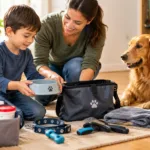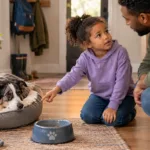
Some children repeatedly open a pet’s gate, enter the animal’s room, or try to remove the pet from its bed. The behavior may come from curiosity, affection, weak impulse control, or confusion about the boundary.
When a child keeps opening a pet’s safe space, repeating “don’t go in there” is rarely enough. Children need a simple rule, a safe alternative, and physical barriers that protect the animal while self-control is still developing.
🐾 The basic idea: A pet’s safe space is a private retreat where the animal can rest without being followed, touched, or removed.
Why Children Keep Opening the Pet’s Safe Space
🔍 Curiosity Is Stronger Than the Rule
A gate, closed door, crate, or covered bed immediately attracts attention. A toddler may not be thinking, “I am breaking the family rule.” They may be thinking, “What is behind there?”
💛 The Child May Be Trying to Help
Some children believe that a pet hiding is sad, lonely, or trapped. They open the gate because they want to rescue the animal or invite it back into family activity.
That intention deserves acknowledgment, but it does not change the boundary: caring for a pet sometimes means allowing it to be alone.
🐶 The Pet’s Retreat Can Look Like an Invitation
A dog lying in a bed or a cat disappearing into a room may seem available because the animal is visible. Children do not automatically understand that quiet body language can mean “I want space.”
🧠 Toddlers Do Not Generalize Rules Well
A child may understand “don’t open the gate while the dog is sleeping” but not apply the same idea when the dog is awake, when a different adult is present, or when the animal moves to another resting place.
Why a Pet’s Safe Space Must Stay Private
A retreat lets the animal end contact before discomfort escalates. If the child can always follow, the space is not truly safe.
- 🛏️ Rest is not rejection.
- 🚪 Walking away is safer than being forced to growl, snap, scratch, or bite.
- 🐾 A private space helps the pet recover from noise, touch, and excitement.
- 👀 The child learns that affection does not mean constant access.
The ASPCA guidance on dogs and babies includes respecting a dog’s body, safe zones, and belongings while actively supervising interactions. Cats and other companion animals also need protected areas, although their preferred retreats and warning signals may differ.
How to Explain That the Space Is Private
🗣️ Use Simple, Consistent Language
Choose one short phrase and use it every time:
“That is the pet’s quiet space. We wait outside.”
Avoid changing the explanation into a long lecture. Young children learn the boundary through repetition and predictable action.
🔄 Explain What the Child Can Do Instead
- “You can sit here and look from outside.”
- “You can choose a toy for us to use later.”
- “You can play on the other side of the room.”
- “When the pet comes out, we can see whether it wants to be near us.”
The pet is not being punished or permanently excluded. When appropriate, it may leave on its own while an adult manages access.
Before setting this boundary, make sure the pet has a comfortable retreat that is appropriate for its species. See our guide to creating a safe retreat space for pets when children are loud.
Build the Boundary Into the Environment
A verbal rule is not enough when a toddler can open the gate in two seconds. The environment must make the safe choice easier.
| 🔒 Tool | How it helps | Important detail |
|---|---|---|
| Baby gate | Creates visible distance around a room or resting area | Use a design the child cannot easily climb or open |
| Childproof latch | Prevents impulsive opening of a pet room or door | Adults must still be able to access the area quickly |
| Raised bed or cat tree | Offers distance and an elevated retreat | Make sure the route is stable and free from chasing |
| Visual boundary | Gives the child a concrete “stop” signal | Keep the location and rule consistent |
Never use a crate or retreat as punishment. Make sure the animal is not trapped without adequate ventilation, appropriate access to water, suitable temperature control, or a safe way for an adult to check on it. Childproofing should block the child’s access without preventing responsible adult access.
For dogs, the ASPCA describes safe zones and escape routes as ways to help an animal move away from uncomfortable interaction. For cats, elevated or hidden areas can provide privacy and control over distance.
Teach Privacy Through Practice, Not Only Correction
Practice the rule when the child is calm and the pet is not inside the space. Stand at the entrance and rehearse:
- Stop at the gate or doorway.
- Look without opening or reaching.
- Wait for the pet to come out on its own when it is safe and appropriate.
- Choose another activity nearby.
Give specific recognition when the child respects the boundary: “You stopped at the gate and kept your hands outside. That protects the pet’s quiet time.”
When it is safe and appropriate, wait for the pet to leave the retreat on its own. If the animal is sick, injured, needs medication, or must be transported, an adult should follow appropriate veterinary or safety guidance instead of asking a child to intervene.
What to Do When Your Child Opens the Gate or Door
Keep the response brief and calm:
- ☐ Close or secure the access point.
- ☐ Move the child away from the pet.
- ☐ Repeat: “That is the pet’s private space.”
- ☐ Offer the alternative activity.
- ☐ Check that the animal can settle or leave safely.
Do not turn the correction into a dramatic confrontation. But do not leave the gate open and hope the next reminder works. Each repeated opportunity allows the same unsafe behavior to become a habit.
What to Do When the Child Tries to Remove the Pet
If the child reaches into the retreat, pulls the animal, or tries to carry it out, intervene immediately without turning the moment into a struggle. Move the child away first, close or secure the barrier, and give the pet space to settle. If the animal is frightened, tense, or showing warning signals, avoid reaching into the retreat or pulling the pet out.
Say, “I won’t let you pull the pet out.” Explain after everyone is separated. The priority is not winning an argument; it is preventing the animal from feeling trapped.
Never remove the pet from its retreat to demonstrate the rule. That teaches the opposite lesson: the animal’s private space can be invaded whenever a person wants access.
Young children should never be left alone with a pet. Separate the child and animal whenever there is fear, tension, pursuit, growling, hissing, a bite attempt, a scratch, or a risk that the pet may bolt. Do not punish warning signals; they are information that more distance is needed.
When Physical Access Control Is Necessary
Physical barriers are especially important when:
- ⚠️ the child repeats the behavior immediately after correction;
- ⚠️ the pet is hiding, freezing, growling, hissing, or trying to escape;
- ⚠️ the space contains food, valued toys, medication, or an injured animal;
- ⚠️ the child can open the barrier without adult help;
- ⚠️ no adult can intervene immediately.
When words are not enough, the adult should secure the barrier, guide the child away, and prevent access without reaching into the pet’s retreat or creating a struggle.
✅ A Simple Family Rule for Pet Privacy
Stop at the entrance. Keep hands outside. Wait for the pet to come out.
This rule applies to ordinary rest periods. Adults may need to access the area for health, safety, or care reasons, but children should not be responsible for deciding when or how that happens.
Every adult should use the same words and follow the same response. Consistency makes the boundary easier to learn and prevents the child from searching for the person who will allow access.
📋 Practical Checklist for Parents
- ☐ Does the pet have a retreat the child cannot enter alone?
- ☐ Is the gate, latch, or door secure enough for this child?
- ☐ Does the child know the short phrase for the boundary?
- ☐ Is there an appealing alternative activity?
- ☐ Can an adult intervene immediately?
- ☐ Does the pet have a clear route away from the child?
- ☐ Are all adults applying the same rule?
FAQ About Children Opening a Pet’s Safe Space
What if my child says the pet is lonely?
Say, “You are thinking about the pet. Rest is one way animals take care of themselves. We can wait and see whether the pet comes out.” Validate the concern without removing the animal.
What if my child keeps opening the gate?
Increase physical control, reduce opportunities for repetition, and practice the rule away from the pet. Repeated opening means the child still needs environmental help, not a longer lecture.
When should I contact a professional?
Seek help if the pet shows fear or aggression, the child repeatedly pursues the animal, injuries occur, or the family cannot create reliable separation. Contact a veterinarian or qualified behavior professional for individualized guidance.
Final Thoughts: Privacy Is Part of Caring for a Pet
Respecting a pet’s safe space is not a lesson in rejection. It is a lesson in care. The child learns that loving an animal includes waiting, observing, and allowing the pet to choose distance.
When teaching children to respect a pet’s space, remember that words are only one part of the plan. Use the same short rule, create reliable physical barriers, offer alternatives, and step in calmly when the child cannot yet control access.
Protect the space first, teach the rule repeatedly, and let the pet decide when to return.
Does your family use a gate, a separate room, or another method to protect the pet’s quiet space? Share what has worked for you in the comments.
Sources and Further Reading
- ASPCA: Dogs and Babies — safe zones, escape routes, supervision, and teaching children to respect a dog’s body and belongings.
- American Veterinary Medical Association: Preventing Dog Bites — supervision and respecting dogs when they are resting, eating, or seeking space.
- VCA Animal Hospitals: Signs Your Dog Is Stressed and How to Relieve It — recognizing stress and providing a safe place to escape stimulation.
- Cats Protection: Cats and Children — creating child-free areas so cats can rest undisturbed.

A father of three and a lifelong dog owner who started CentralUnify.com after years of figuring out — often the hard way — how to raise kids and pets who genuinely get along. Between school mornings, homework, and life with two very different dogs, Biscuit (an easygoing older lab) and Pepper (a younger terrier mix with a mind of her own), he’s learned a thing or two about keeping a busy household running without losing his sanity. When he’s not writing, he’s probably refereeing whose turn it is to feed the dogs.